
VISION BOARD · SELF-CARE
Self-care vision board: ideas, an example and a free template
Self-care vision board ideas that turn into real rest: calm pictures, gentle words, an example board, a free template and small daily habits to keep.
The short answer
A self-care vision board should show the few things that actually restore you, such as sleep, walks, quiet mornings or time with friends, plus two or three words for how you want to feel. Keep it short. Then pick one tile and make it a small daily habit you can still do on a tired day.
Search for self-care vision boards and you will see bubble baths, face masks and smoothie bowls. Those are fine, but most self-care is less photogenic: going to bed on time, eating lunch, saying no, taking a walk. A useful board shows your real list, not a spa brochure.
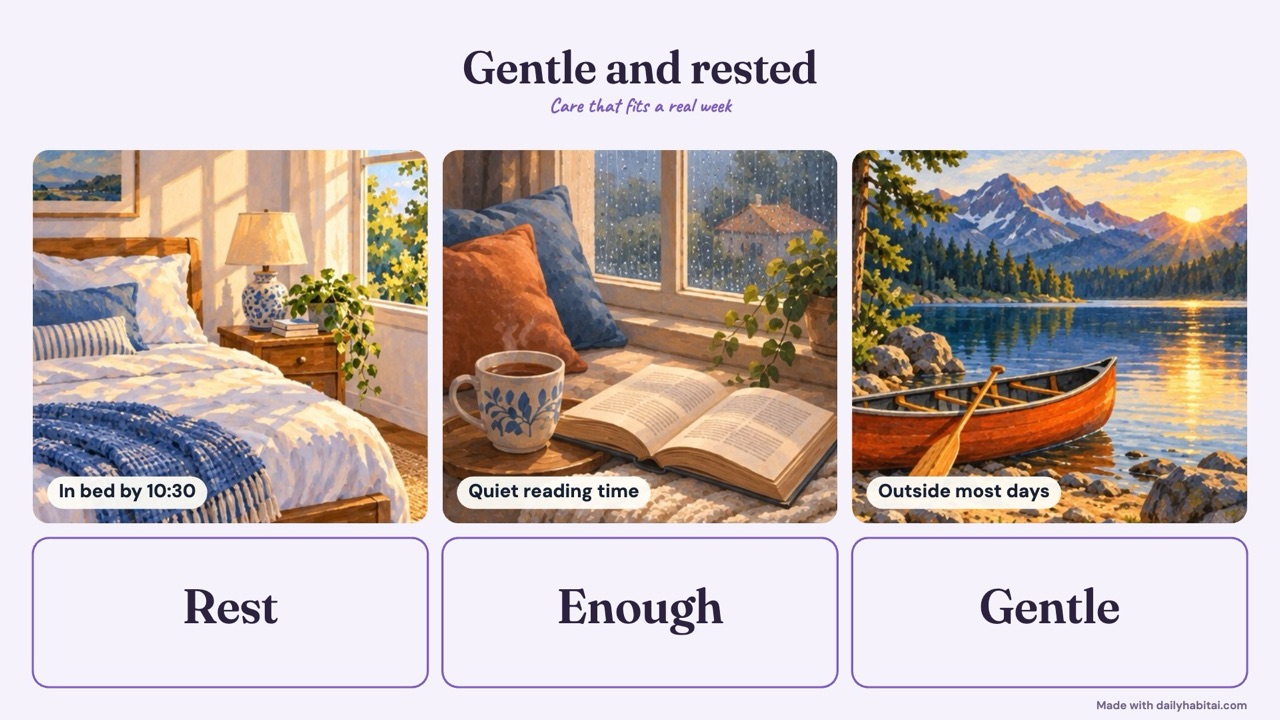
Keep this board small on purpose. A crowded board of everything you should do for yourself turns rest into another to-do list. Six tiles are enough: three pictures of what restores you and three words for how you want to feel.
Self-care vision board ideas
Pictures to use
- A made bed in soft morning light
- Tea and a book on a window seat
- A walking path or park near your home
- A glass of water on your desk
- A bath with a candle and a towel
- A short skincare shelf with just the basics
- A journal and a pen
- A phone face down in a basket
- A simple home-cooked lunch
- A yoga mat or stretching corner
- Two friends laughing over coffee
- A calendar with one free evening circled
- A meditation cushion by a window
- Fresh flowers on the table
- A cat asleep on a sunny windowsill
- Headphones and a favorite playlist
- A closed laptop at the end of the workday
Words and phrases
- Rest
- Enough
- Gentle
- Slow mornings
- Soft evenings
- No is a full sentence
- Breathe
- Unhurried
- Refill first
- Quiet time
- In bed early
- Nourished
- Outside daily
- Protect my peace
- Kind to myself
- Offline hour
Print these and more with the vision board words sheet.
How to make a self-care vision board
- List what actually makes you feel better after a hard week. Cross out anything you only do because it looks nice online.
- Choose three items from that list, one for body, one for mind and one for connection, and find a picture for each.
- Pick three words for how you want to feel, like rested, steady or light, and place them under the pictures.
- Write the smallest version of each picture on a sticky note, such as ten minutes outside or lights off at 10:30.
- Keep the board by your bed or on your lock screen, and check once a week which tile you actually did.
VISION BOARD + DAILYHABITAI APP
How to use your vision board with the DailyHabitAI app
Your board shows what you want. The free app handles the how: one picture becomes a 30-day plan with a small daily step and a reminder. No account, it stays on your phone.
From tile to daily habit
| Tile on your board | Daily habit in the app | Start |
|---|---|---|
| In bed by 10:30 | Dim the lights and put my phone on the charger, after I brush my teeth | Make it my plan |
| Quiet reading time | Read 10 pages, after I pour my evening tea | Make it my plan |
| Outside most days | Walk 10 minutes outside, after lunch | Make it my plan |
Five ways to use the board and the app together
- Board to plan in about two minutes. In the vision board maker, tap Make it a habit under any tile. The plan builder opens with your goal and your reason already filled in.
- Two nudges a day. Set the board as your lock screen and turn on the app's reminder at your cue time. You see the why on your wallpaper and get the small step from the app.
- Three goals at a time. The app keeps up to three active habits. Pick three tiles for this season, then archive one and bring in the next when it feels easy.
- Busy weeks do not break the board. Every day in the plan has a two-minute hard-day version, so a tile keeps moving even on a bad day.
- A monthly check-in. The app prompts short reviews on days 7, 14, 21 and 28. On the first of each month, look at the board and swap any picture that no longer fits.
Common mistakes to avoid
- Treating self-care as shopping, so the board fills with products instead of routines.
- Adding so many tiles that the board becomes another list of ways you are falling short.
- Choosing only big resets like a spa weekend and nothing you can do on an ordinary Tuesday.
- Using the board in place of help you need; if you feel low or anxious for weeks, talk to a doctor or counselor.
Frequently asked questions
What do you put on a self-care vision board?
Put the routines that restore you, not just products. Common tiles are sleep, a daily walk, quiet reading, time with friends, journaling and cooking a real meal. Add two or three feeling words such as rested or calm. Keep it to six to nine tiles so the board feels restful to look at.
How is a self-care vision board different from a self-love vision board?
A self-care board is about actions that refill you, like sleep, walks or a quiet evening. A self-love board is about how you see and speak to yourself, such as kinder words, boundaries and pride in small wins. Many people combine them, but separating them keeps each board clear.
Does a self-care vision board actually help?
The board is a reminder, not a treatment. Studies suggest that imagining a nice outcome alone can reduce effort, while specific if-then plans help people follow through. So pair each picture with a when and where, like reading ten pages after pouring evening tea, and notice whether it happens.
Can I make a self-care vision board on my phone?
Yes. A phone wallpaper is one of the easiest formats because you see it many times a day. Use three to six images with plenty of empty space so icons do not cover them. Our free maker exports a phone wallpaper size, and the DailyHabitAI app can remind you of the habit behind one tile.
Sources and evidence
- Oettingen & Mayer (2002): The motivating function of thinking about the future: Expectations versus fantasies — Across four studies, positive fantasies about a desired future predicted lower effort and poorer results later, while positive expectations predicted higher effort and success. Picturing a goal is not enough on its own.
- Gollwitzer & Sheeran (2006): Implementation intentions and goal achievement: A meta-analysis of effects and processes — Across 94 independent tests, if-then plans that say when, where and how you will act had a medium-to-large effect (d = .65) on reaching goals.
- Pham & Taylor (1999): From thought to action: Effects of process- versus outcome-based mental simulations on performance — Students who pictured the process of studying, not just the good grade, studied more and earned better grades. Picturing the steps beats picturing only the result.