
VISION BOARD · COUPLES
Couples vision board: ideas, an example and a free template
Couples vision board ideas to plan your life together: 18 pictures, 18 words, an example board, questions to talk through and shared habits.
The short answer
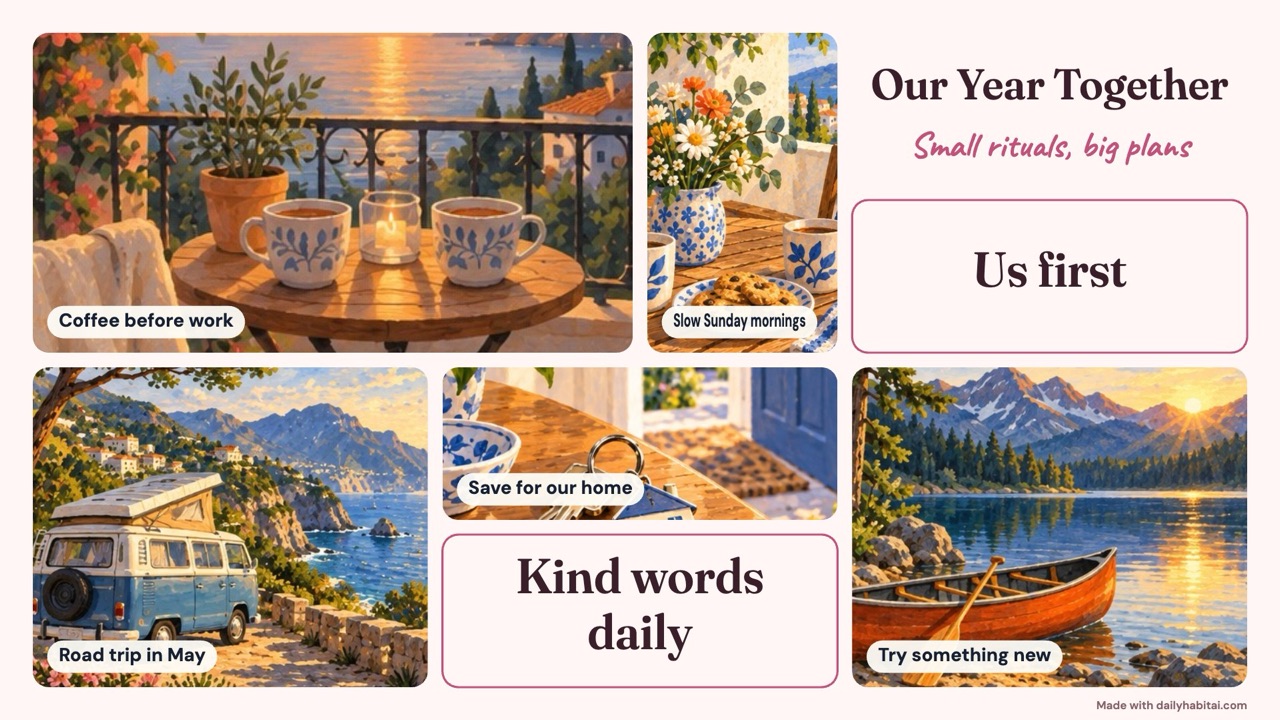
A couples vision board should show the life you both want, chosen together. Talk first, then pick 5 to 8 pictures: time together, a shared trip, home, money, health and a tradition. Under each, write one small shared habit, such as a weekly walk or a phone-free dinner, and review it together monthly.
Most couples boards show honeymoon beaches, dream homes and quotes about love. Those are fine starting points. The boards couples keep using also show ordinary time together: coffee before work, a walk after dinner, a date night on the calendar.
This page gives you questions to talk through, picture and word ideas, an example board and three shared habits you can start in the DailyHabitAI app. It is for any couple, whether dating, engaged or married. It is not relationship counseling.
Couples vision board ideas
Pictures to use
- Two coffee cups where you start the day
- A table set for a phone-free dinner
- A trip you are planning together
- Your future home or a room you want to redo
- A class to take together, like dancing or cooking
- A trail or park for weekend walks
- A calendar with a monthly date night
- A shared savings jar with a target
- A kitchen where you cook together
- A pet you hope to adopt
- A board game or puzzle night
- A garden you want to grow
- Flowers for no reason
- A new city to explore for a weekend
- A journal for notes to each other
- Both families around one table
- A tent under the stars
- A photo of the two of you on a happy day
Words and phrases
- Us first
- Date night
- Kind words daily
- Try new things
- Listen more
- Our home
- Adventure together
- Slow Sundays
- Team us
- Laugh often
- Plan together
- Phones down
- Grow together
- Say thank you
- Our traditions
- Choose each other
- Weekend walks
- Stay curious
Print these and more with the vision board words sheet.
How to make a couples vision board
- Talk before you pick anything: each person names three things they want this year, then find the overlaps.
- Agree on 5 to 8 shared themes, and give each partner at least one personal tile.
- Choose the pictures together, and write one shared habit or plan under each.
- Name one likely obstacle, like busy weeks, and agree on an if-then plan for it.
- Hang the board where you both see it and review it together once a month over coffee.
VISION BOARD + DAILYHABITAI APP
How to use your vision board with the DailyHabitAI app
Your board shows what you want. The free app handles the how: one picture becomes a 30-day plan with a small daily step and a reminder. No account, it stays on your phone.
From tile to daily habit
| Tile on your board | Daily habit in the app | Start |
|---|---|---|
| Coffee before work | Sit together for 10 minutes with phones in another room, after we pour our coffee | Make it my plan |
| Kind words daily | Write one thing I appreciated about my partner today, before bed | Make it my plan |
| Try something new | Take a 15-minute walk together on a new route, after dinner | Make it my plan |
Five ways to use the board and the app together
- Board to plan in about two minutes. In the vision board maker, tap Make it a habit under any tile. The plan builder opens with your goal and your reason already filled in.
- Two nudges a day. Set the board as your lock screen and turn on the app's reminder at your cue time. You see the why on your wallpaper and get the small step from the app.
- Three goals at a time. The app keeps up to three active habits. Pick three tiles for this season, then archive one and bring in the next when it feels easy.
- Busy weeks do not break the board. Every day in the plan has a two-minute hard-day version, so a tile keeps moving even on a bad day.
- A monthly check-in. The app prompts short reviews on days 7, 14, 21 and 28. On the first of each month, look at the board and swap any picture that no longer fits.
Common mistakes to avoid
- One partner making the board and presenting it as shared.
- Only big goals, like a house or a wedding, with nothing for this week.
- Using the board to hint at complaints instead of talking about them directly.
- Never updating it after a big change, like a move or a new job.
Frequently asked questions
What should a couples vision board include?
Include time together, a shared adventure, home, money, health and one tradition you want to keep. Give each partner room for a personal goal too. Under each picture, write a small shared habit, like a weekly walk, so the board shapes your normal week and not only the big milestones.
How do you make a vision board as a couple?
Start with a conversation, not scissors. Each of you lists what you want this year, then circle the overlaps. Choose pictures together and write one action under each. Set a monthly check-in date, and decide in advance what you will do when a busy week gets in the way.
What are good couples vision board ideas?
Popular ideas include a trip, a home project, a savings goal, a class together, a monthly date night, phone-free dinners and a new hobby. In lab experiments, couples who did a short novel and challenging task together reported a bigger rise in relationship quality than couples doing a mundane one.
What if we want different things?
That is normal and useful to know. Put the shared goals in the middle and give each person a section of their own. Talk about differences directly rather than settling them on the board. If disagreements feel stuck or painful, a licensed couples therapist can help.
Sources and evidence
- Aron et al. (2000): Couples' shared participation in novel and arousing activities and experienced relationship quality — Surveys linked shared exciting activities with relationship satisfaction, and in three experiments couples who did a 7-minute novel and arousing task together showed greater increases in experienced relationship quality than couples doing a mundane task.
- Oettingen & Mayer (2002): The motivating function of thinking about the future: Expectations versus fantasies — Across four studies, positive fantasies about a desired future predicted lower effort and poorer performance weeks to two years later, while positive expectations predicted higher effort and success.
- Gollwitzer & Sheeran (2006): Implementation intentions and goal achievement: A meta-analysis of effects and processes — Across 94 independent tests, if-then plans that specify when, where and how to act had a medium-to-large effect (d = .65) on goal attainment.