
VISION BOARD · CAREER
Career vision board: ideas, an example and a free template
Career vision board ideas for job seekers and career changers: 18 pictures, 18 words, an example board, and daily habits that build real skills.
The short answer
A career vision board should show the work you want to be doing and the skills that get you there. Include your target role or project, two or three skills to build, people you want to learn from, and one weekly action per picture, such as an hour of focused practice.
Career boards online often feature corner offices, salary numbers and company logos. Those can help you name a direction. They rarely show the part you control: the skill you practice, the portfolio piece you finish, the conversation you schedule.
This page covers picture and word ideas, an example board and how to turn a career picture into a daily habit. It works for job seekers, career changers and students heading into their first role.
Career vision board ideas
Pictures to use
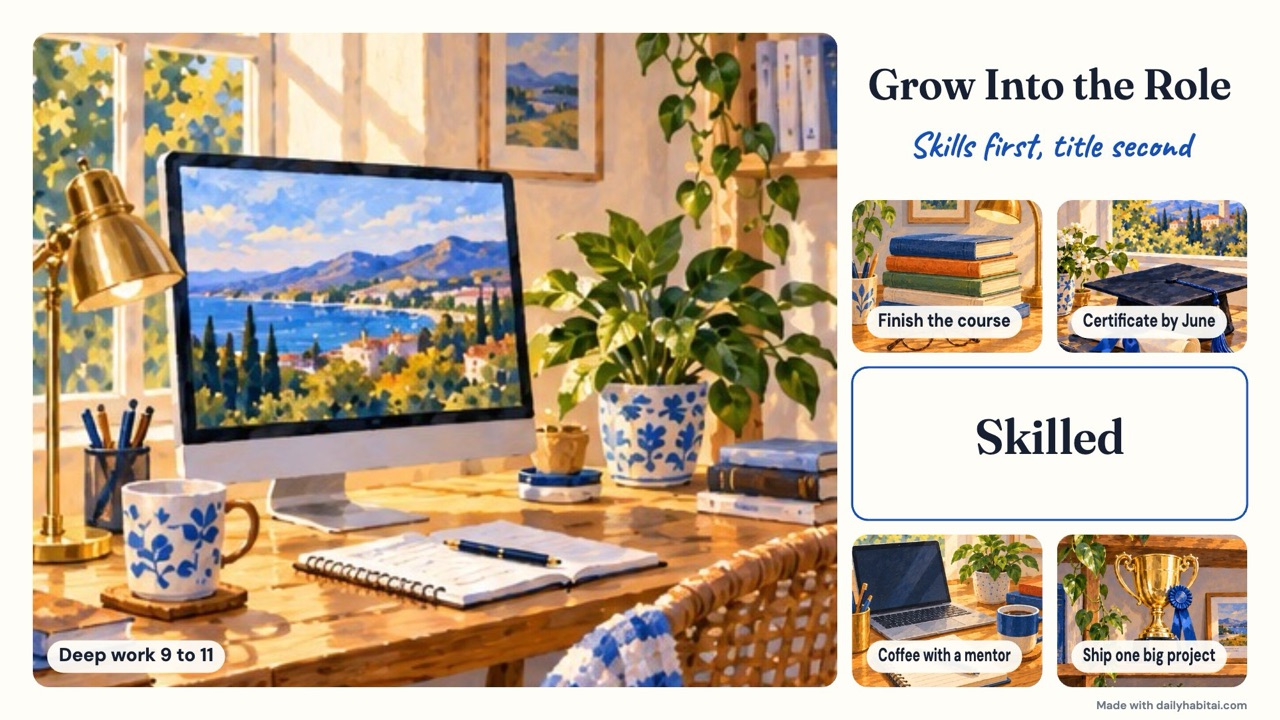
- A desk set up for focused work
- A company or building you admire, as a direction
- A certificate or course you want to finish
- A book by an expert in your field
- A portfolio page with your best work
- A conference or meetup badge
- A slide from a talk you want to give
- A mentor or colleague you want to learn from
- A calendar with a protected focus block
- The tool you want to master, like a spreadsheet or code editor
- A resume with one new line on it
- An outfit for interviews
- A trophy or team win
- A notebook for weekly reflections
- A graduation cap for a degree or license
- A remote or hybrid workspace
- A team you want to lead
- A shorter commute
Words and phrases
- Skilled
- Do the deep work
- Learn in public
- Lead with care
- Ship it
- Ask for feedback
- Better every quarter
- Portfolio over promises
- Next role
- Mentor and be mentored
- Focus
- Grow
- Say it clearly
- Protect the mornings
- Curious
- Proud of my work
- Build the network
- Finish strong
Print these and more with the vision board words sheet.
How to make a career vision board
- Write where you want to be in one to three years in one sentence: a role, a project or a kind of work.
- List the two or three skills or proofs of work that stand between you and that sentence.
- Find a picture for each skill and one for the destination, and make the destination the biggest tile.
- Under each skill picture, write one weekly action, like one lesson, one portfolio piece or one outreach message.
- Review the board at the end of each month and update the actions, not the destination.
VISION BOARD + DAILYHABITAI APP
How to use your vision board with the DailyHabitAI app
Your board shows what you want. The free app handles the how: one picture becomes a 30-day plan with a small daily step and a reminder. No account, it stays on your phone.
From tile to daily habit
| Tile on your board | Daily habit in the app | Start |
|---|---|---|
| Deep work 9 to 11 | Do 25 minutes of focused work with notifications off, after I open my laptop | Make it my plan |
| Finish the course | Study one lesson for 20 minutes, after dinner | Make it my plan |
| Coffee with a mentor | Write three lines about what I learned today, after work | Make it my plan |
Five ways to use the board and the app together
- Board to plan in about two minutes. In the vision board maker, tap Make it a habit under any tile. The plan builder opens with your goal and your reason already filled in.
- Two nudges a day. Set the board as your lock screen and turn on the app's reminder at your cue time. You see the why on your wallpaper and get the small step from the app.
- Three goals at a time. The app keeps up to three active habits. Pick three tiles for this season, then archive one and bring in the next when it feels easy.
- Busy weeks do not break the board. Every day in the plan has a two-minute hard-day version, so a tile keeps moving even on a bad day.
- A monthly check-in. The app prompts short reviews on days 7, 14, 21 and 28. On the first of each month, look at the board and swap any picture that no longer fits.
Common mistakes to avoid
- Putting only a salary number or job title on the board, with no skill or action.
- Copying someone else's career path instead of picturing work you actually enjoy.
- Planning ten new skills at once so none gets steady practice.
- Keeping the board somewhere you never look while planning your week.
Frequently asked questions
What should I put on a career vision board?
Put the role or project you are aiming for, the skills that get you there, the people you want to learn from and a picture of your ideal workday. Under each picture, write one action you can take this week. That turns the board from a wish into a work plan.
How is a career vision board different from a career plan?
A plan lists steps and dates, while a board keeps the direction in view. They work best together. In one study, students who pictured the process of studying studied more and earned better grades than students who pictured the good grade. So picture the practice, not only the promotion.
Can I make a career vision board for a job search?
Yes. Picture the kind of team and work you want rather than one employer. Add weekly targets you control, such as five tailored applications or two networking messages, and track them. Across 138 randomized studies, monitoring progress improved goal attainment.
Do career vision boards work?
They help as reminders, not as magic. Positive fantasies about success predicted less effort in several studies, while mental contrasting with if-then plans had a small-to-medium effect on goal attainment across 21 studies. So add the likely obstacle and your plan for it next to each picture.
Sources and evidence
- Pham & Taylor (1999): From thought to action: Effects of process- versus outcome-based mental simulations on performance — College freshmen who mentally simulated the process of studying for 5 to 7 days before a midterm studied more and earned better grades than those who simulated the outcome.
- Oettingen & Mayer (2002): The motivating function of thinking about the future: Expectations versus fantasies — Across four studies, positive fantasies about a desired future predicted lower effort and poorer performance weeks to two years later, while positive expectations predicted higher effort and success.
- Wang, Wang & Gai (2021): A meta-analysis of the effects of mental contrasting with implementation intentions on goal attainment — Across 21 studies with 24 effect sizes (15,907 participants), mental contrasting with implementation intentions had a small-to-medium effect on goal attainment (g = 0.336), with possible publication bias.
- Harkin et al. (2016): Does monitoring goal progress promote goal attainment? A meta-analysis of the experimental evidence — Across 138 randomized studies (N = 19,951), interventions that increased progress monitoring promoted goal attainment (d = 0.40), with larger effects when progress was physically recorded or made public.
- Gollwitzer & Sheeran (2006): Implementation intentions and goal achievement: A meta-analysis of effects and processes — Across 94 independent tests, if-then plans that specify when, where and how to act had a medium-to-large effect (d = .65) on goal attainment.