
VISION BOARD · HEALTH
Health vision board: ideas, an example and a free template
Health vision board ideas for sleep, food, movement and calm: 18 pictures, 18 words, an example board and small daily routines to match each one.
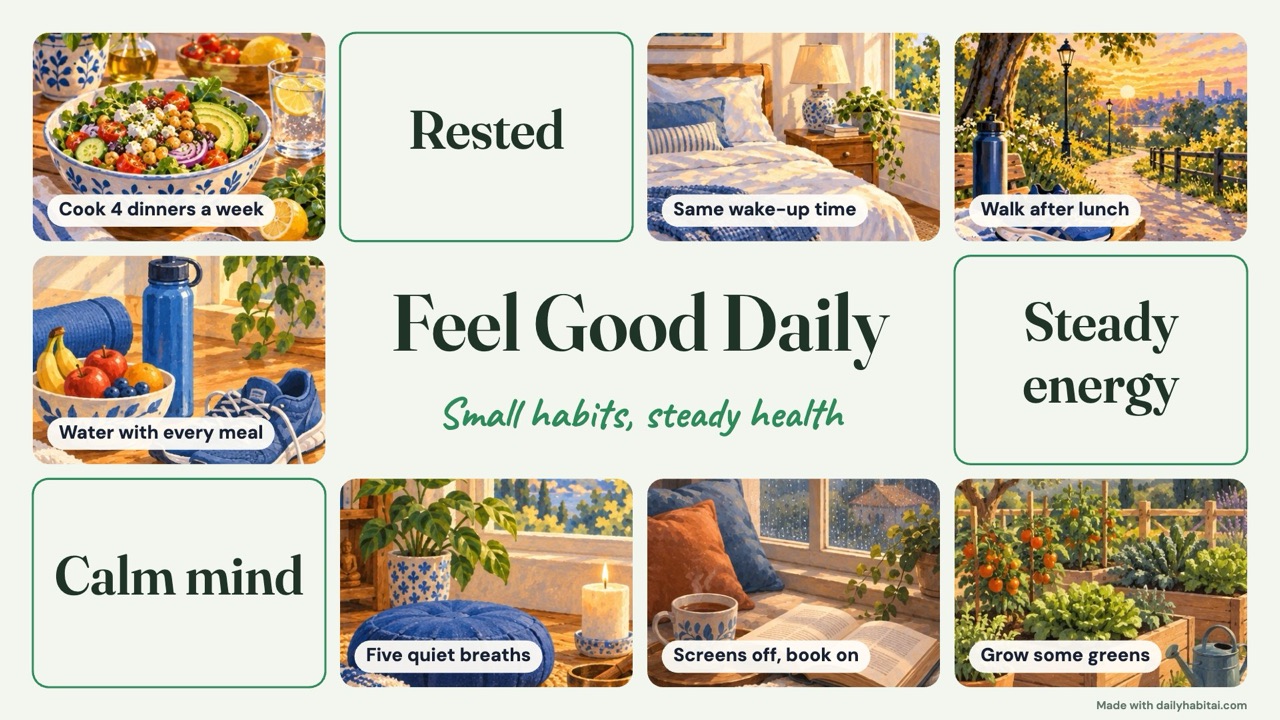
The short answer
A health vision board should show the daily basics you want more of: sleep, movement, home-cooked food, water and calm. Choose 5 to 10 pictures and give each one a small routine, such as a 10-minute walk after lunch. Keep the board where your day starts. It is a reminder, not a treatment.
Health boards often mix green smoothies, target weights and spa photos. The useful ones are more ordinary. They show a regular bedtime, a filled water bottle, a walk after dinner and a bowl of food you actually like to cook.
Below are picture and word ideas, an example board you can edit, and three examples of turning a picture into a daily habit. This page is general information, not medical advice. Talk to a doctor about health conditions, medicines or big changes to diet and exercise.
Health vision board ideas
Pictures to use
- A made bed in morning light
- An alarm clock set to the same time every day
- A filled water bottle on your desk
- A colorful plate of vegetables you like
- A weekly grocery list
- A pot of soup for the week
- A walking path near home
- A pair of comfortable walking shoes
- A quiet corner with a cushion
- Herbal tea and a book at night
- A phone charging outside the bedroom
- A fruit bowl on the counter
- A stretching mat
- A calendar reminder for a yearly checkup
- An herb pot or small vegetable garden
- Sunlight through a window in the morning
- A warm bath or shower that helps you unwind
- A friend you walk with each week
Words and phrases
- Rested
- Nourished
- Steady energy
- Calm mind
- Early to bed
- Drink water
- Move a little
- Kind to my body
- Home cooked
- Fresh air
- Slow down
- Same bedtime
- Breathe
- Strong and well
- Less scrolling
- Walk after meals
- Eat more plants
- Feel good daily
Print these and more with the vision board words sheet.
How to make a health vision board
- List the four basics you most want to improve: sleep, movement, food and stress. Pick two for now.
- Find one picture for each basic that shows a moment in your day, like your bed at 10:30 p.m. or your kitchen on Sunday.
- Write one small routine under each picture, sized so you could still do it on a tired day.
- Add a word or two for how you want to feel, such as rested or steady.
- Put the board where your day starts, and review it each Sunday: keep what worked and shrink what did not.
VISION BOARD + DAILYHABITAI APP
How to use your vision board with the DailyHabitAI app
Your board shows what you want. The free app handles the how: one picture becomes a 30-day plan with a small daily step and a reminder. No account, it stays on your phone.
From tile to daily habit
| Tile on your board | Daily habit in the app | Start |
|---|---|---|
| Same wake-up time | Get up at 7 a.m. and open the curtains, when my alarm rings | Make it my plan |
| Cook 4 dinners a week | Prep one vegetable for tomorrow's dinner, after dinner | Make it my plan |
| Five quiet breaths | Sit and breathe slowly for 3 minutes, after I get home | Make it my plan |
Five ways to use the board and the app together
- Board to plan in about two minutes. In the vision board maker, tap Make it a habit under any tile. The plan builder opens with your goal and your reason already filled in.
- Two nudges a day. Set the board as your lock screen and turn on the app's reminder at your cue time. You see the why on your wallpaper and get the small step from the app.
- Three goals at a time. The app keeps up to three active habits. Pick three tiles for this season, then archive one and bring in the next when it feels easy.
- Busy weeks do not break the board. Every day in the plan has a two-minute hard-day version, so a tile keeps moving even on a bad day.
- A monthly check-in. The app prompts short reviews on days 7, 14, 21 and 28. On the first of each month, look at the board and swap any picture that no longer fits.
Common mistakes to avoid
- Filling the board with diet rules or target weights instead of routines you control.
- Changing sleep, food, exercise and screen time all in the same week.
- Using the board as a substitute for medical care when something feels wrong.
- Picking wellness images that look pretty but that you would never actually do.
Frequently asked questions
What goes on a health vision board?
Pictures of the everyday routines that support health: a regular bedtime, meals you cook, walks, water and quiet time. Give each picture one small action and add a few words for how you want to feel. Leave out calorie targets and body comparisons, which tend to turn the board into a scorecard.
Should I put sleep on a health vision board?
Yes, if sleep is a weak spot. Aim the picture at a regular schedule, not only more hours. In 60,977 UK Biobank participants, more regular sleep timing was linked to a 20% to 48% lower risk of death from any cause than the least regular group. That is an association, not proof.
How many health goals should I put on the board?
Two to four is plenty for the first month. A new routine needs repetition in a steady context to become automatic, and in one study that took anywhere from 18 to 254 days. Add a new picture only when an earlier routine starts to feel easy.
Can a vision board improve my health?
Not by itself. A board can remind you of routines that support health, and the reminder works best with a plan. If-then plans, such as "after dinner, I walk 10 minutes," improved goal attainment across 94 tests. For symptoms or conditions, see a doctor.
Sources and evidence
- Windred et al. (2024): Sleep regularity is a stronger predictor of mortality risk than sleep duration: A prospective cohort study — In 60,977 UK Biobank participants, higher sleep regularity was associated with a 20% to 48% lower risk of all-cause mortality across the top four regularity quintiles versus the least regular; regularity was a stronger predictor than duration.
- Lally et al. (2010): How are habits formed: Modelling habit formation in the real world — In 96 volunteers repeating an eating, drinking or activity behavior daily in the same context, time to 95% of peak automaticity ranged from 18 to 254 days, and missing one opportunity did not materially affect the process.
- Gollwitzer & Sheeran (2006): Implementation intentions and goal achievement: A meta-analysis of effects and processes — Across 94 independent tests, if-then plans that specify when, where and how to act had a medium-to-large effect (d = .65) on goal attainment.
- Oettingen & Mayer (2002): The motivating function of thinking about the future: Expectations versus fantasies — Across four studies, positive fantasies about a desired future predicted lower effort and poorer performance weeks to two years later, while positive expectations predicted higher effort and success.