
VISION BOARD · BUCKET LIST
Bucket list vision board: ideas, an example and a free template
Bucket list vision board ideas with 12 checkable dreams, an example board, a free template and how to plan the first step for each item.
The short answer
A bucket list vision board shows 10 to 20 experiences you want to have, each with a picture and a checkbox. Mix big trips with small, local items so you can tick some off this year. Under each item, write the first step, like check the best season, price flights or book a lesson.
A bucket list is a list; a vision board is a picture. Put them together and you get a board of experiences you can actually check off. Most bucket list boards online are travel photos. Travel is great, but finished lists usually include cheaper, closer items too: learn to swim, watch a sunrise, bake a family recipe.
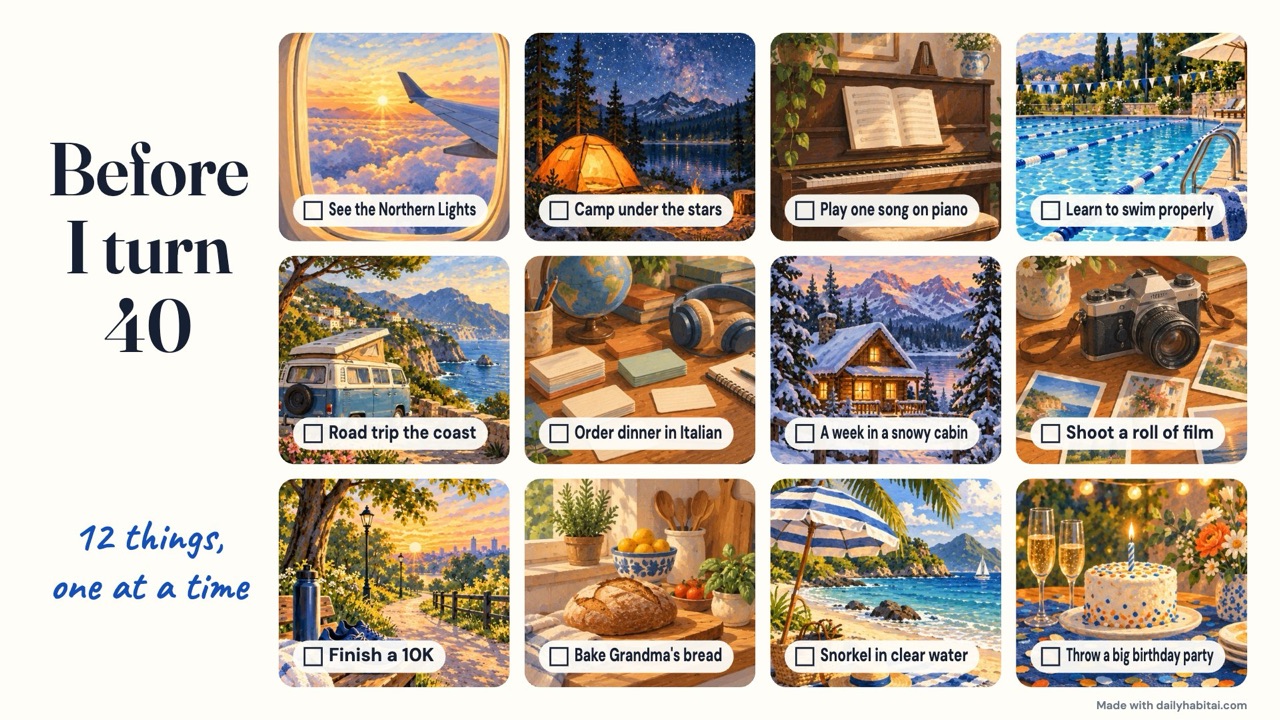
The trick is to give every tile a first step. Seeing the Northern Lights is a dream. Looking up the best months and starting a travel fund is a step. This example uses twelve tiles with checkboxes, so you can watch progress fill in as the year goes on.
Bucket list vision board ideas
Pictures to use
- Northern Lights over snow
- A tent under the stars by a lake
- A hot air balloon at sunrise
- Piano keys or a guitar
- A swimming pool lane
- A camper van on a coastal road
- A passport with a new stamp
- A race bib at a finish line
- A family recipe card
- Snorkel gear in clear water
- A mountain summit you can hike
- A concert or festival crowd
- A film camera and prints
- Language flashcards
- A volunteer day with friends
- A letter to your future self
- A local museum you have never visited
- A sunrise you got up early to see
Words and phrases
- Say yes
- Someday is now
- One by one
- Go see it
- Learn something new
- Brave enough
- First time
- Check it off
- Near and far
- Adventure
- Collect moments
- Small and wild
- Why not me
- This year
- Stories to tell
Print these and more with the vision board words sheet.
How to make a bucket list vision board
- Brain-dump every experience you have ever wanted, without judging. Aim for 30 or more.
- Sort them into far (needs travel or big savings), near (possible this year) and skill (needs practice). Pick twelve, with at least four near ones.
- Find one picture per item and write it as a short, checkable line, like see the Northern Lights instead of travel more.
- On the back of the board or in a notes app, write the first step and a rough month for each item.
- Tick the box the day you finish an item, add a photo from the day, and replace it with a new dream.
VISION BOARD + DAILYHABITAI APP
How to use your vision board with the DailyHabitAI app
Your board shows what you want. The free app handles the how: one picture becomes a 30-day plan with a small daily step and a reminder. No account, it stays on your phone.
From tile to daily habit
| Tile on your board | Daily habit in the app | Start |
|---|---|---|
| Order dinner in Italian | Practice Italian for 10 minutes, after I start the coffee maker | Make it my plan |
| Finish a 10K | Walk or jog for 15 minutes, after work | Make it my plan |
| Play one song on piano | Practice piano for 10 minutes, after dinner | Make it my plan |
Five ways to use the board and the app together
- Board to plan in about two minutes. In the vision board maker, tap Make it a habit under any tile. The plan builder opens with your goal and your reason already filled in.
- Two nudges a day. Set the board as your lock screen and turn on the app's reminder at your cue time. You see the why on your wallpaper and get the small step from the app.
- Three goals at a time. The app keeps up to three active habits. Pick three tiles for this season, then archive one and bring in the next when it feels easy.
- Busy weeks do not break the board. Every day in the plan has a two-minute hard-day version, so a tile keeps moving even on a bad day.
- A monthly check-in. The app prompts short reviews on days 7, 14, 21 and 28. On the first of each month, look at the board and swap any picture that no longer fits.
Common mistakes to avoid
- Making every item an expensive trip, so nothing gets checked off for years.
- Writing vague items like be more adventurous that can never be ticked.
- Skipping the first step, which is usually small, like checking dates or booking one lesson.
- Leaving finished items on the board instead of celebrating them and adding a new one.
Frequently asked questions
What should be on a bucket list vision board?
Choose experiences you can clearly check off: trips, skills, events and small local adventures. Aim for about twelve, with a mix of big and small. Each tile needs a picture, a short line and a checkbox. Examples include see the Northern Lights, learn to swim, run a 10K and bake a family recipe.
What is the difference between a bucket list and a vision board?
A bucket list is a set of experiences you want to have at some point in life. A vision board is a visual reminder of goals, often for one year. A bucket list vision board combines both: pictures of specific experiences you can tick off, reviewed and refreshed each year.
How many items should a bucket list vision board have?
Twelve is a practical number for one board, about one per month. Keep a longer written list elsewhere and rotate items onto the board. Research on goal tracking suggests that recording progress helps, especially when it is written down, so checkboxes you can see filling up are worth having.
How do I make a digital bucket list vision board?
Open our free vision board maker, choose the bucket list layout, and replace each tile with your own photo and item. Download it as a phone wallpaper or print it for the fridge. A digital board is easy to update when you check off an item and add the next one.
Sources and evidence
- Harkin et al. (2016): Does monitoring goal progress promote goal attainment? A meta-analysis of the experimental evidence — Across 138 studies (N = 19,951), interventions that increased progress monitoring promoted goal attainment (d = 0.40), with larger effects when progress was physically recorded or made public.
- Gollwitzer & Sheeran (2006): Implementation intentions and goal achievement: A meta-analysis of effects and processes — Across 94 independent tests, if-then plans that say when, where and how you will act had a medium-to-large effect (d = .65) on reaching goals.
- Oettingen & Mayer (2002): The motivating function of thinking about the future: Expectations versus fantasies — Across four studies, positive fantasies about a desired future predicted lower effort and poorer results later, while positive expectations predicted higher effort and success. Picturing a goal is not enough on its own.