
VISION BOARD · BUSINESS
Business vision board: ideas, an example and a free template
Business vision board ideas for small and side businesses: 18 pictures, 18 words, an example board, and weekly actions you control. No hype.
The short answer
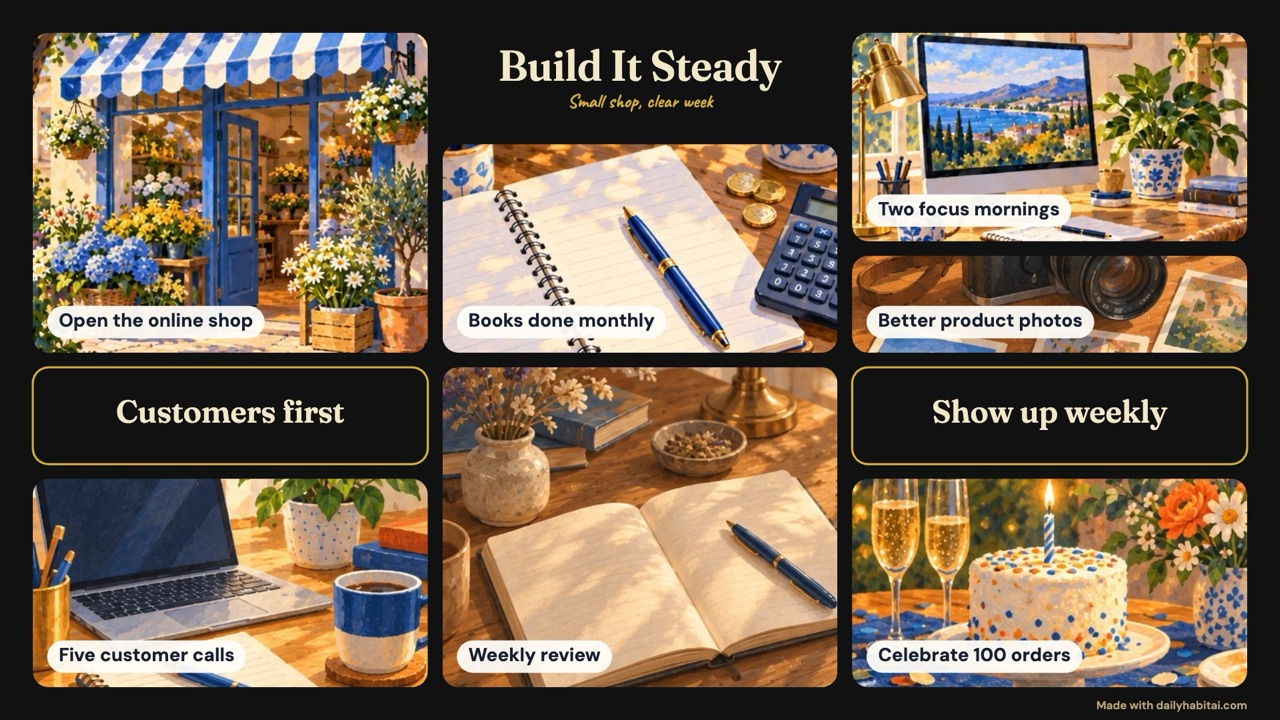
A business vision board for a small or side business should show the customers you serve, the product you want to launch and the weekly work behind it. Pick 6 to 9 pictures and give each a measurable action you control, such as five customer calls a week. Review it monthly against your real numbers.
Many business boards lean on revenue charts, luxury cars and big income numbers. A target can be a fine direction, but no board produces income. What you control is the work: calls, posts, product tests and finished orders.
This page is for small business owners and people building a side business. It gives picture and word ideas, an example board and three ways to turn a picture into a daily habit. It is not financial, tax or legal advice.
Business vision board ideas
Pictures to use
- Your shop front, website or market stall
- The product you want to launch this year
- A happy customer using what you make
- A workspace with room to pack orders
- A notebook with your weekly numbers
- A calendar with two protected work blocks
- Product photos you want to reshoot
- A booth at a local market or fair
- A handwritten thank-you card for customers
- A mentor or small business group
- A laptop open to your email list
- A tidy shelf of inventory
- A day off you protect
- A first hire or collaborator
- An open sign on the door
- A simple bookkeeping spreadsheet
- A packaging design you love
- A small celebration for a milestone
Words and phrases
- Customers first
- Show up weekly
- Make it simple
- Ship, then improve
- Ask what they need
- Steady growth
- Done beats perfect
- Protect the day off
- Know your numbers
- Local and loved
- Build slowly
- Serve well
- One offer at a time
- Say it clearly
- Quality over quantity
- Test small
- Proud of the work
- Open for business
Print these and more with the vision board words sheet.
How to make a business vision board
- Write one sentence about the business you want in a year: who you serve and what you sell.
- Pick one picture for the customer, one for the product and a few for the work that makes it happen.
- Add measurable actions you control, like posts per week or customer calls, rather than income promises.
- Add one picture for rest or a protected day off, so the board does not become a to-do list for burnout.
- Review the board against your weekly numbers each month and change one action at a time.
VISION BOARD + DAILYHABITAI APP
How to use your vision board with the DailyHabitAI app
Your board shows what you want. The free app handles the how: one picture becomes a 30-day plan with a small daily step and a reminder. No account, it stays on your phone.
From tile to daily habit
| Tile on your board | Daily habit in the app | Start |
|---|---|---|
| Two focus mornings | Work 30 minutes on the business before email, after my morning coffee | Make it my plan |
| Weekly review | Write three lines about what sold and what did not, after I close the shop | Make it my plan |
| Five customer calls | Send one message to a customer or lead, after lunch | Make it my plan |
Five ways to use the board and the app together
- Board to plan in about two minutes. In the vision board maker, tap Make it a habit under any tile. The plan builder opens with your goal and your reason already filled in.
- Two nudges a day. Set the board as your lock screen and turn on the app's reminder at your cue time. You see the why on your wallpaper and get the small step from the app.
- Three goals at a time. The app keeps up to three active habits. Pick three tiles for this season, then archive one and bring in the next when it feels easy.
- Busy weeks do not break the board. Every day in the plan has a two-minute hard-day version, so a tile keeps moving even on a bad day.
- A monthly check-in. The app prompts short reviews on days 7, 14, 21 and 28. On the first of each month, look at the board and swap any picture that no longer fits.
Common mistakes to avoid
- Pinning revenue figures or luxury items as if the board will produce them.
- Filling every tile with growth goals and none with customers or the product.
- Choosing actions you do not control, like "go viral," instead of "post twice a week."
- Never comparing the board with your real weekly numbers.
Frequently asked questions
What should I put on a business vision board?
Picture your customer, your product or service, your workspace and the weekly work behind it. Add a word for how you want to run the business, such as steady or simple. Under each picture, write an action you control, like a weekly number of calls, posts or product tests.
Should I put revenue goals on a business vision board?
You can put a target on the board, but treat it as a direction, not a promise. In research on thinking about the future, positive fantasies about a desired outcome predicted less effort later. Pair any number with the actions that could move it and the obstacle most likely to get in the way.
How do I make a vision board for a side business?
Keep it small. Choose one offer, one customer group and the hours you can really give it, such as two mornings a week. Add a picture of your day job or family time too, so the board respects your limits. Then track each work session.
How often should I update a business vision board?
Look at it weekly and update it monthly or quarterly, comparing it with your real numbers. In a meta-analysis of 138 randomized studies, monitoring progress improved goal attainment, with larger effects when progress was recorded. Replace a tile when its action no longer fits the business.
Sources and evidence
- Oettingen & Mayer (2002): The motivating function of thinking about the future: Expectations versus fantasies — Across four studies, positive fantasies about a desired future predicted lower effort and poorer performance weeks to two years later, while positive expectations predicted higher effort and success.
- Harkin et al. (2016): Does monitoring goal progress promote goal attainment? A meta-analysis of the experimental evidence — Across 138 randomized studies (N = 19,951), interventions that increased progress monitoring promoted goal attainment (d = 0.40), with larger effects when progress was physically recorded or made public.
- Gollwitzer & Sheeran (2006): Implementation intentions and goal achievement: A meta-analysis of effects and processes — Across 94 independent tests, if-then plans that specify when, where and how to act had a medium-to-large effect (d = .65) on goal attainment.