
VISION BOARD · FAITH
Faith vision board: Christian and spiritual ideas, with an example
Faith vision board ideas for Christian and other spiritual lives: prayer, scripture reading, service, an example board and small daily habits.
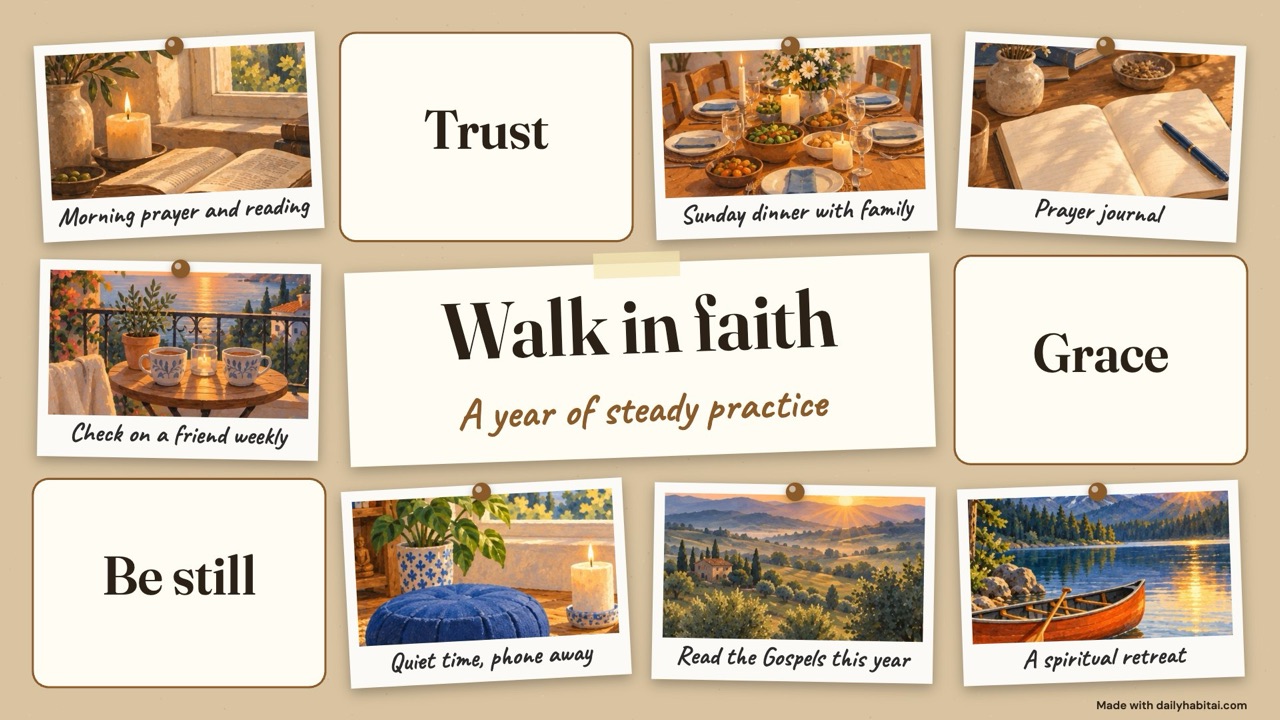
The short answer
A faith vision board shows the spiritual life you hope to grow into: time for prayer or reflection, reading sacred texts, community, rest and service. Christians often add a verse reference and a theme word like Trust. Pair each picture with a small daily practice so the board points toward action, not only hope.
Christian vision boards are among the most searched faith boards. They usually combine a verse, a theme word and pictures of prayer, family and church life. Some Christians prefer to call it a prayer board, to keep the focus on seeking God rather than getting things. Either name works here. The board is simply a visible reminder of what you are praying about and practicing.
People of other faiths, and people who call themselves spiritual, make these boards too: a Shabbat table, a prayer mat, a meditation cushion, a temple visit, a quiet walk. This page gives Christian examples alongside notes for other traditions. It does not tell you what to believe. It helps you turn the practices you already value into small daily habits.
Faith vision board ideas
Pictures to use
- An open Bible or other sacred text by a window
- A candle and a prayer journal
- The church, chapel, mosque, synagogue or temple you attend
- A family table set for Sunday or Shabbat dinner
- A sunrise over hills for morning prayer
- A small group or study circle
- Hands serving food at a community kitchen
- A bookmark in a reading plan
- A quiet corner with a cushion
- A walk in nature for reflection
- A hymnbook, choir or worship music
- A prayer mat, rosary or mala
- Two friends talking over coffee
- A retreat center or quiet cabin
- An olive branch or a garden
- A handwritten card for someone who is struggling
- A calendar with a weekly rest day marked
Words and phrases
- Trust
- Grace
- Be still
- Walk in faith
- Gratitude
- Serve
- Hope
- Rooted
- Peace
- Faithful in small things
- Sabbath rest
- Love your neighbor
- Pray first
- Patience
- Renewal
- Humility
Print these and more with the vision board words sheet.
How to make a faith vision board
- Begin with prayer, reflection or quiet, and ask what you want to grow in this year rather than what you want to get.
- Choose one theme word and, if you like, a verse or passage reference to go with it. The reference alone fits a tile better than the full text.
- Pick pictures for the practices that support that growth: prayer, reading, worship, rest, service and people.
- Under each picture, write the smallest weekly version, such as read one chapter on Sunday or call one person who is lonely.
- Keep the board near where you pray or read, and review it on your weekly day of rest or at the start of each month.
VISION BOARD + DAILYHABITAI APP
How to use your vision board with the DailyHabitAI app
Your board shows what you want. The free app handles the how: one picture becomes a 30-day plan with a small daily step and a reminder. No account, it stays on your phone.
From tile to daily habit
| Tile on your board | Daily habit in the app | Start |
|---|---|---|
| Morning prayer and reading | Read one short passage and pray for 2 minutes, after I pour my morning coffee | Make it my plan |
| Prayer journal | Write one line of thanks or prayer, after I get into bed | Make it my plan |
| Quiet time, phone away | Sit in silence for 5 minutes with my phone in another room, after lunch | Make it my plan |
Five ways to use the board and the app together
- Board to plan in about two minutes. In the vision board maker, tap Make it a habit under any tile. The plan builder opens with your goal and your reason already filled in.
- Two nudges a day. Set the board as your lock screen and turn on the app's reminder at your cue time. You see the why on your wallpaper and get the small step from the app.
- Three goals at a time. The app keeps up to three active habits. Pick three tiles for this season, then archive one and bring in the next when it feels easy.
- Busy weeks do not break the board. Every day in the plan has a two-minute hard-day version, so a tile keeps moving even on a bad day.
- A monthly check-in. The app prompts short reviews on days 7, 14, 21 and 28. On the first of each month, look at the board and swap any picture that no longer fits.
Common mistakes to avoid
- Filling the board with possessions and calling it faith; many believers prefer to focus on character, service and trust.
- Adding a long list of spiritual disciplines at once, then feeling guilty when none of them last.
- Leaving out people, even though most traditions practice faith in community, not only alone.
- Copying someone else's verses or practices instead of choosing what fits your tradition and season of life.
Frequently asked questions
Is it okay for Christians to make a vision board?
Christians hold different views. Some avoid the term because of its link with manifestation teaching and call it a prayer board instead. Others see it as a planning tool, like a journal. Many focus the board on growth, service and trust rather than possessions. A pastor or your church community can help you think it through.
What do you put on a Christian vision board?
Common tiles are a verse reference, a theme word such as Trust or Grace, pictures of prayer and Bible reading, church and small group, family, rest and a way to serve others. Some add a reading plan or a prayer list. Keep it to eight to twelve tiles so each one gets attention.
Can I make a spiritual vision board if I am not Christian?
Yes. Jewish, Muslim, Hindu, Buddhist, Sikh and other believers make them, as do people who are spiritual but not religious. Use pictures of your own practices, such as a Shabbat table, a prayer mat, a meditation cushion or a walk in nature, and words from your own tradition.
How do I turn a faith vision board into daily practice?
Pick one tile and make it tiny and tied to something you already do. For example, after pouring morning coffee, read one short passage and pray for two minutes. Research on if-then plans shows that naming when and where you will act helps people follow through on their intentions.
Sources and evidence
- Gollwitzer & Sheeran (2006): Implementation intentions and goal achievement: A meta-analysis of effects and processes — Across 94 independent tests, if-then plans that say when, where and how you will act had a medium-to-large effect (d = .65) on reaching goals.
- Pham & Taylor (1999): From thought to action: Effects of process- versus outcome-based mental simulations on performance — Students who pictured the process of studying, not just the good grade, studied more and earned better grades. Picturing the steps beats picturing only the result.
- Harkin et al. (2016): Does monitoring goal progress promote goal attainment? A meta-analysis of the experimental evidence — Across 138 studies (N = 19,951), interventions that increased progress monitoring promoted goal attainment (d = 0.40), with larger effects when progress was physically recorded or made public.