
VISION BOARD · FITNESS
Fitness vision board: ideas, an example and a free template
Fitness vision board ideas that lead to real workouts: 18 pictures, 18 words, an example board, and how to turn each photo into a daily habit.
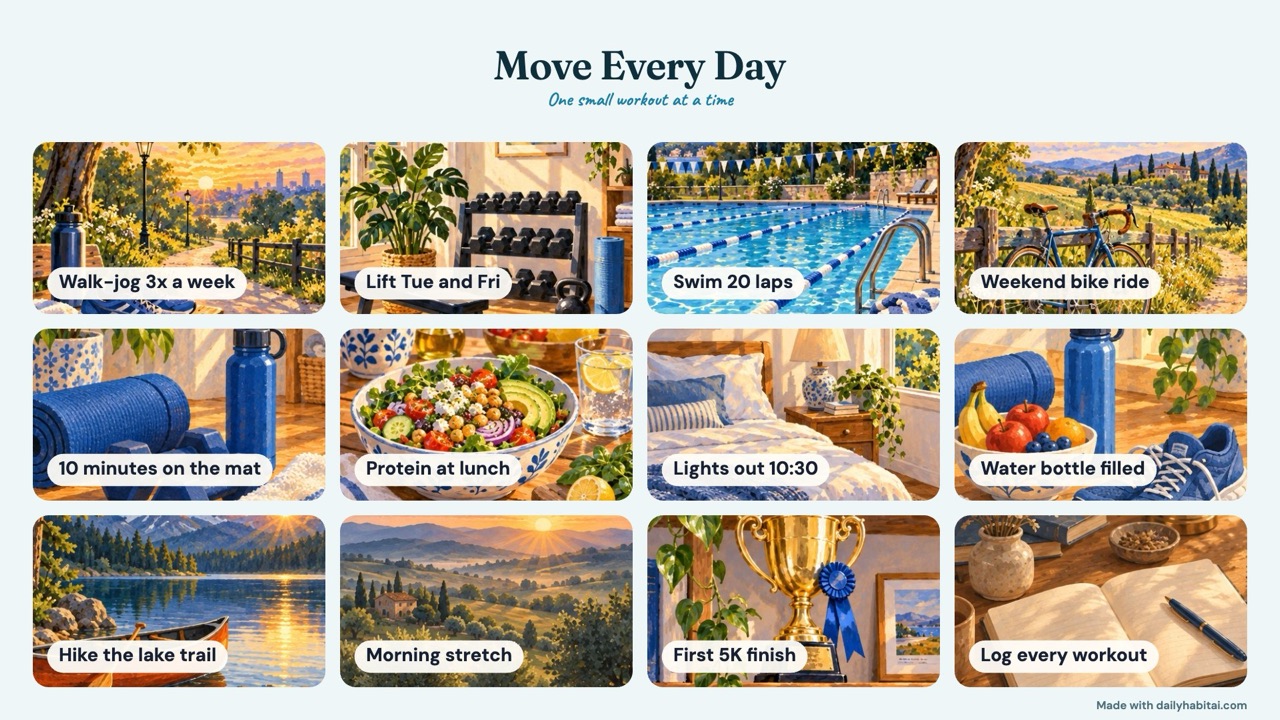
The short answer
A fitness vision board should show the workouts you want to do, not only the body you want. Pick 6 to 12 pictures of specific activities, such as a morning run or a strength class. Add one number goal to each picture and write the weekly action under it. Then put the first workout on your calendar.
Most fitness boards online are full of athletes and before-and-after photos. Those can feel exciting for a day and discouraging by week three. A board works better as a picture of your own training week: the path you walk, the weights you lift, the pool you swim in.
This page gives you picture and word ideas, an example board you can open in our free maker, and a simple way to turn each picture into a small daily habit. It is not medical advice. If you have a health condition or have not exercised in a long time, check with a doctor before a big change.
Fitness vision board ideas
Pictures to use
- Your own running shoes by the door
- A park loop near home you can walk in 20 minutes
- A weight rack with the dumbbells you actually use
- A pool lane at your open-swim hour
- A yoga mat rolled out in your living room
- A bicycle on a trail near you
- A 5K race bib or finish line
- A hiking trail you want to reach by summer
- A group class or friend you want to train with
- A pull-up bar or a set of resistance bands
- A calendar with three workout days circled
- A filled water bottle
- A simple protein breakfast
- A made bed for recovery sleep
- A stretch you want to hold for a full minute
- A sport or dance style you loved as a kid
- A kettlebell one size heavier than today
- A workout log page full of check marks
Words and phrases
- Move every day
- Stronger, not perfect
- Show up
- Three times a week
- First 5K
- Strong back
- Rest counts
- Just the warm-up
- Walk it out
- Consistency over intensity
- Lift, stretch, repeat
- Better than last month
- Energy
- Mobility
- One more lap
- Healthy and able
- Sweat and smile
- Keep the streak kind
Print these and more with the vision board words sheet.
How to make a fitness vision board
- Pick one or two fitness goals for the next three months, such as finishing a 5K or lifting twice a week.
- Choose pictures of the activity itself, ideally places near you, rather than the bodies of strangers.
- Under each picture, write the weekly action and its day, such as "Tue and Fri, 30 minutes of weights."
- Add one if-then plan for your biggest obstacle: "If it rains, then I do a 15-minute workout video at home."
- Hang the board or set it as your lock screen, and check off each workout on a tracker the same day.
VISION BOARD + DAILYHABITAI APP
How to use your vision board with the DailyHabitAI app
Your board shows what you want. The free app handles the how: one picture becomes a 30-day plan with a small daily step and a reminder. No account, it stays on your phone.
From tile to daily habit
| Tile on your board | Daily habit in the app | Start |
|---|---|---|
| Walk-jog 3x a week | Walk or jog 15 minutes, after work | Make it my plan |
| Morning stretch | Stretch for 5 minutes, after I brush my teeth | Make it my plan |
| Lights out 10:30 | Put my phone on the charger outside the bedroom, at 10 p.m. | Make it my plan |
Five ways to use the board and the app together
- Board to plan in about two minutes. In the vision board maker, tap Make it a habit under any tile. The plan builder opens with your goal and your reason already filled in.
- Two nudges a day. Set the board as your lock screen and turn on the app's reminder at your cue time. You see the why on your wallpaper and get the small step from the app.
- Three goals at a time. The app keeps up to three active habits. Pick three tiles for this season, then archive one and bring in the next when it feels easy.
- Busy weeks do not break the board. Every day in the plan has a two-minute hard-day version, so a tile keeps moving even on a bad day.
- A monthly check-in. The app prompts short reviews on days 7, 14, 21 and 28. On the first of each month, look at the board and swap any picture that no longer fits.
Common mistakes to avoid
- Using before-and-after photos or other people's bodies, which can turn the board into a judgment.
- Setting only outcome goals, like a weight number, with no action you control this week.
- Starting five new workouts at once instead of one you can repeat.
- Treating one missed day as failure instead of starting again at the next cue.
Frequently asked questions
What should I put on a fitness vision board?
Put pictures of the activities you want to do, the places you will do them and one measurable goal for each. Add a few words for how you want to feel, like strong or steady. Skip photos that make you feel judged. Each picture should point to something you can do this week.
Should I use before-and-after photos on a fitness vision board?
We suggest not. Comparison photos focus on an outcome you cannot control day to day, and they can make the board feel like a verdict. A photo of your running path or gym bag points at the action. If you track body changes, keep them in a private log.
How long does it take to build an exercise habit?
It varies a lot. In a study of 111 new gym members, exercising at least four times a week for about six weeks was the minimum to form an exercise habit. Simple, consistent workouts helped most. In another study, missing one day did not materially slow habit formation.
Does a fitness vision board actually work?
A board alone will not make you fitter. Research suggests that daydreaming about the result can lower effort, while picturing the steps and making if-then plans helps. Use the board as a reminder of your weekly workouts and pair it with a tracker. Recording progress improved goal attainment across 138 studies.
Sources and evidence
- Kaushal & Rhodes (2015): Exercise habit formation in new gym members: a longitudinal study — In 111 new gym members followed for 12 weeks, exercising at least four times a week for six weeks was the minimum to establish an exercise habit; consistency, low complexity, environment and enjoyment predicted habit strength.
- Lally et al. (2010): How are habits formed: Modelling habit formation in the real world — In 96 volunteers repeating an eating, drinking or activity behavior daily in the same context, time to 95% of peak automaticity ranged from 18 to 254 days, and missing one opportunity did not materially affect the process.
- Pham & Taylor (1999): From thought to action: Effects of process- versus outcome-based mental simulations on performance — College freshmen who mentally simulated the process of studying for 5 to 7 days before a midterm studied more and earned better grades than those who simulated the outcome.
- Oettingen & Mayer (2002): The motivating function of thinking about the future: Expectations versus fantasies — Across four studies, positive fantasies about a desired future predicted lower effort and poorer performance weeks to two years later, while positive expectations predicted higher effort and success.
- Gollwitzer & Sheeran (2006): Implementation intentions and goal achievement: A meta-analysis of effects and processes — Across 94 independent tests, if-then plans that specify when, where and how to act had a medium-to-large effect (d = .65) on goal attainment.
- Harkin et al. (2016): Does monitoring goal progress promote goal attainment? A meta-analysis of the experimental evidence — Across 138 randomized studies (N = 19,951), interventions that increased progress monitoring promoted goal attainment (d = 0.40), with larger effects when progress was physically recorded or made public.