
VISION BOARD · MONEY
Money vision board: saving ideas, an example and a free template
Money vision board ideas built on habits: saving, spending less and paying down debt. 18 pictures, 18 words, an example board and daily routines.
The short answer
A money vision board works best when it shows habits, not piles of cash. Pick one to three goals, such as a starter emergency fund or paying off a card. Add a picture and a target for each, then write the routine behind it, like a weekly transfer or a no-spend day. Track it monthly.
Money boards often show stacks of bills, luxury cars and slogans about financial freedom. This page sticks to everyday money habits: saving a little on a schedule, spending less on purpose and paying down debt with a routine. This is general information, not financial advice.
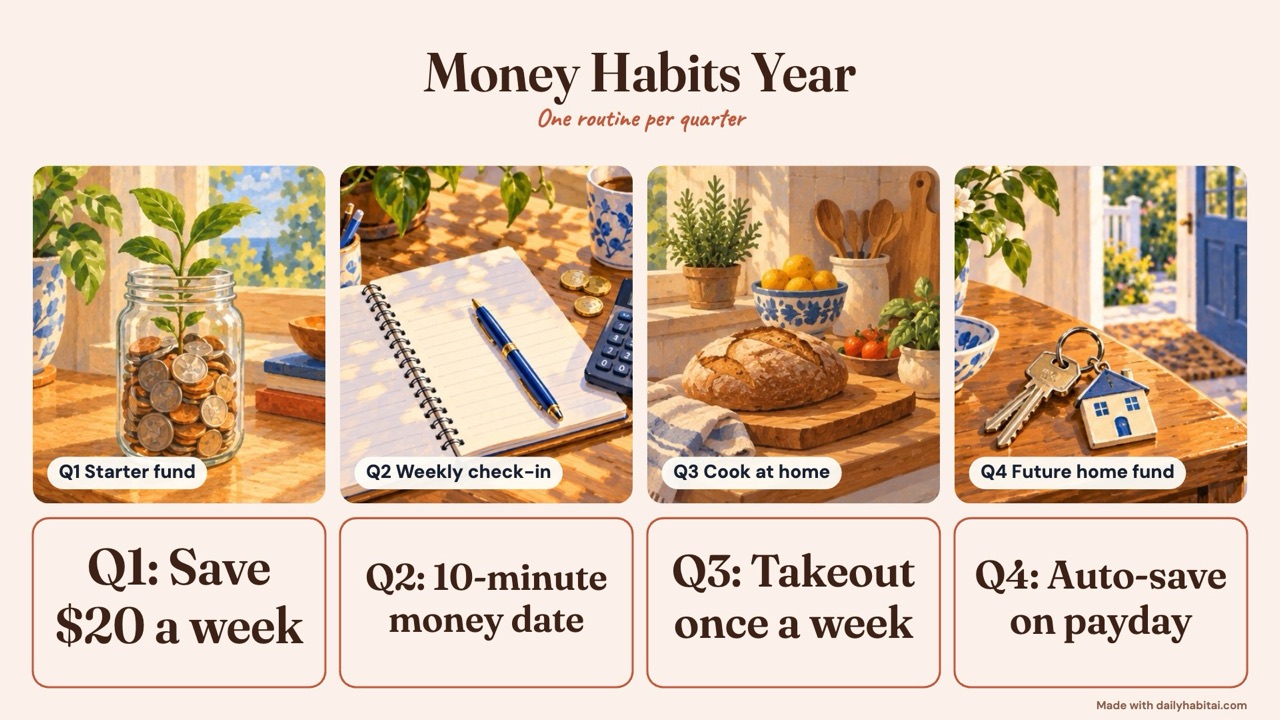
Below you will find picture and word ideas, a quarter-by-quarter example board and three ways to turn money pictures into small daily habits, such as cooking at home more or noting what you spent. For decisions about your own situation, talk to a qualified professional.
Money vision board ideas
Pictures to use
- A coin jar with a savings target on the label
- A notebook, calculator and coins for a weekly check-in
- A credit card with a paid-off date written beside it
- Your kitchen, for cooking more meals at home
- A packed lunch
- A library card for free books and movies
- House keys for a future home fund
- A calendar with payday circled
- A savings thermometer you color in
- A grocery list
- A picnic instead of a restaurant meal
- A secondhand find you love
- An envelope labeled for one goal
- A trip you pay for in cash
- A cozy evening at home
- A pile of receipts you sort weekly
- A progress bar for debt payoff
- Coffee made at home
Words and phrases
- Save first
- Spend on purpose
- Debt-free steps
- Cook at home
- Pay myself first
- Enough
- Small and steady
- Money date
- One card at a time
- Needs before wants
- Emergency fund
- No-spend Sunday
- Track it
- Future me says thanks
- Plan the treats
- Calm about money
- Every dollar has a job
- Pack the lunch
Print these and more with the vision board words sheet.
How to make a money vision board
- Pick one to three money goals with a number and a date, such as a $500 starter fund by spring.
- Choose a picture for each goal and one for the habit that funds it, like your kitchen for cooking at home.
- Write the routine under each picture: a transfer on payday, a weekly check-in or a no-spend day.
- Add a simple tracker, like a thermometer you color in, so progress is visible on the board.
- Review once a month; if a routine did not happen, make it smaller rather than dropping it.
VISION BOARD + DAILYHABITAI APP
How to use your vision board with the DailyHabitAI app
Your board shows what you want. The free app handles the how: one picture becomes a 30-day plan with a small daily step and a reminder. No account, it stays on your phone.
From tile to daily habit
| Tile on your board | Daily habit in the app | Start |
|---|---|---|
| Q3 Cook at home | Plan tomorrow's dinner from what is already in the fridge, after dinner | Make it my plan |
| Q2 Weekly check-in | Write down what I spent today in two minutes, after I brush my teeth at night | Make it my plan |
| Q1 Starter fund | Keep shopping apps off my home screen and wait a day before buying, when I pick up my phone | Make it my plan |
Five ways to use the board and the app together
- Board to plan in about two minutes. In the vision board maker, tap Make it a habit under any tile. The plan builder opens with your goal and your reason already filled in.
- Two nudges a day. Set the board as your lock screen and turn on the app's reminder at your cue time. You see the why on your wallpaper and get the small step from the app.
- Three goals at a time. The app keeps up to three active habits. Pick three tiles for this season, then archive one and bring in the next when it feels easy.
- Busy weeks do not break the board. Every day in the plan has a two-minute hard-day version, so a tile keeps moving even on a bad day.
- A monthly check-in. The app prompts short reviews on days 7, 14, 21 and 28. On the first of each month, look at the board and swap any picture that no longer fits.
Common mistakes to avoid
- Filling the board with luxury images that make your current life feel like a failure.
- Setting a savings goal with no routine or date behind it.
- Treating the board as a financial plan; it does not replace advice on debt, taxes or investing.
- Leaving the numbers off because they feel uncomfortable, which removes the feedback.
Frequently asked questions
What do you put on a money vision board?
Put one to three specific goals, such as an emergency fund, a paid-off card or a trip paid in cash, each with a number and a date. Then add pictures of the habits that fund them, like cooking at home or a weekly money check-in. Keep luxury images to a minimum.
Can a vision board help me save money?
Only through the habits it reminds you of. Pleasant fantasies about a goal predicted lower effort in several studies, while tracking helped: across 138 randomized studies, monitoring progress improved goal attainment, especially when progress was physically recorded. A savings thermometer you color in is a simple way to do that.
What are good money habits for a vision board?
Common ones are saving a set amount on payday, a 10-minute weekly spending review, cooking at home on most nights, waiting a day before unplanned purchases and paying a little extra on one debt. Pick one or two, not all five, and add more once they feel routine.
Is this page financial advice?
No. This page covers everyday habits and how to picture them. It does not tell you how to invest, which debts to pay first or how to handle taxes. For decisions like those, talk to a qualified financial professional or a nonprofit credit counselor.
Sources and evidence
- Harkin et al. (2016): Does monitoring goal progress promote goal attainment? A meta-analysis of the experimental evidence — Across 138 randomized studies (N = 19,951), interventions that increased progress monitoring promoted goal attainment (d = 0.40), with larger effects when progress was physically recorded or made public.
- Oettingen & Mayer (2002): The motivating function of thinking about the future: Expectations versus fantasies — Across four studies, positive fantasies about a desired future predicted lower effort and poorer performance weeks to two years later, while positive expectations predicted higher effort and success.
- Gollwitzer & Sheeran (2006): Implementation intentions and goal achievement: A meta-analysis of effects and processes — Across 94 independent tests, if-then plans that specify when, where and how to act had a medium-to-large effect (d = .65) on goal attainment.