
VISION BOARD · SELF-LOVE
Self-love vision board: ideas, an example and a free template
Self-love vision board ideas that go past pink quotes: kind words, boundaries, pictures for each life area, an example board and small daily habits.
The short answer
A self-love vision board shows how you want to treat yourself: kind words you can believe, boundaries you want to keep, and small acts of care. Use one picture for each life area, such as rest, body, friends and growth, and write one gentle action under each picture instead of a verdict about yourself.
Most self-love boards online are pink collages of affirmations like I am enough. Words can help, but a sentence you do not yet believe can feel hollow. A board works better when it also shows what self-respect looks like in practice: sleeping enough, keeping a promise to yourself, leaving a conversation that feels unkind.
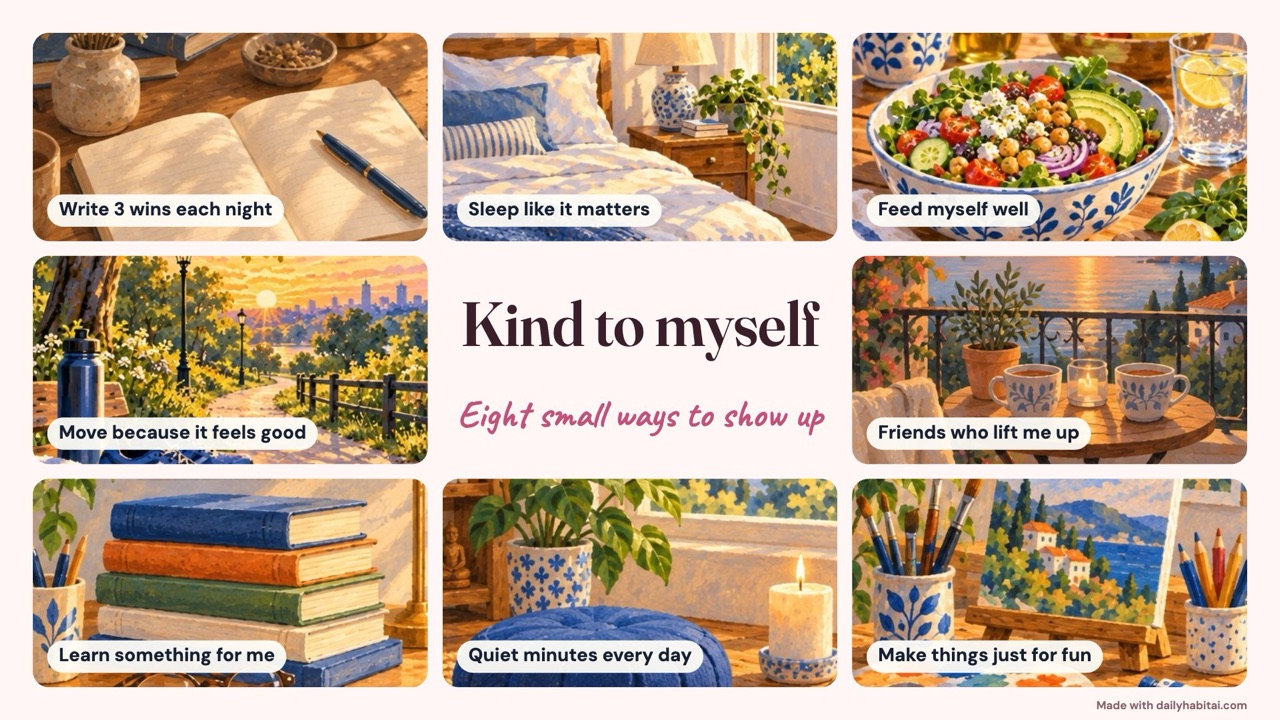
This page uses a life-areas layout: one picture for each part of life, each with a short caption. It helps you notice where you are hard on yourself and where you already take care. Then you pick one tile and turn it into a daily habit small enough to keep on a bad day.
Self-love vision board ideas
Pictures to use
- A journal with a short list of wins
- A mirror with a kind sticky note you wrote
- A made bed
- A meal you cooked just for yourself
- Running shoes by the door
- A calendar with one evening blocked for you
- Friends around a table
- A stack of books you chose for fun
- A paint palette or craft supplies
- A phone set to do not disturb
- A photo of you as a child
- A certificate or small award you earned
- A field of wildflowers
- A cozy sweater and a cup of tea
- A simple skincare shelf
- An open door leading outside
- A handwritten letter to yourself
Words and phrases
- I am learning
- Kind words only
- Enough for today
- Worth the effort
- Boundaries are care
- Proud of small wins
- My own pace
- Soft and strong
- Rest without guilt
- Trust myself
- Keep my promises
- Speak like a friend
- Growing, not fixing
- Take up space
- Show up for me
- Gentle
Print these and more with the vision board words sheet.
How to make a self-love vision board
- Write down how you talk to yourself on a bad day. Take the harshest line and write a kinder version you could almost believe.
- Choose up to eight life areas that matter to you, such as rest, body, friends, work, learning, play, home and money.
- For each area, find one picture of what caring for yourself would look like there, not what you think you should look like.
- Caption each picture with an action, not a verdict: sleep by 11 instead of be perfect.
- Keep the board somewhere private if that feels safer, and add a small sticker each time you keep a promise to yourself.
VISION BOARD + DAILYHABITAI APP
How to use your vision board with the DailyHabitAI app
Your board shows what you want. The free app handles the how: one picture becomes a 30-day plan with a small daily step and a reminder. No account, it stays on your phone.
From tile to daily habit
| Tile on your board | Daily habit in the app | Start |
|---|---|---|
| Write 3 wins each night | Write three small wins, after I get into bed | Make it my plan |
| Move because it feels good | Walk or stretch for 10 minutes, after my morning coffee | Make it my plan |
| Quiet minutes every day | Sit and breathe for 5 minutes, after I get home | Make it my plan |
Five ways to use the board and the app together
- Board to plan in about two minutes. In the vision board maker, tap Make it a habit under any tile. The plan builder opens with your goal and your reason already filled in.
- Two nudges a day. Set the board as your lock screen and turn on the app's reminder at your cue time. You see the why on your wallpaper and get the small step from the app.
- Three goals at a time. The app keeps up to three active habits. Pick three tiles for this season, then archive one and bring in the next when it feels easy.
- Busy weeks do not break the board. Every day in the plan has a two-minute hard-day version, so a tile keeps moving even on a bad day.
- A monthly check-in. The app prompts short reviews on days 7, 14, 21 and 28. On the first of each month, look at the board and swap any picture that no longer fits.
Common mistakes to avoid
- Filling the board with body-change goals and calling it self-love.
- Using affirmations that feel false, which can leave you feeling worse; try starting with I am learning to.
- Comparing your board to polished ones online and deciding yours is not good enough.
- Making every tile a big change instead of one small promise you can keep today.
Frequently asked questions
What should I put on a self-love vision board?
Include kind phrases you can believe, pictures of care like rest, good food and friends, and a few reminders of what you have already done well. Add one boundary you want to keep. Leave out images that make you compare yourself to others. The board should feel like encouragement.
Do affirmations on a vision board work?
It depends on the person. In one set of experiments, people with low self-esteem who repeated a very positive statement about themselves felt worse, not better. Softer phrases like I am learning to rest may be easier to accept. Pairing a phrase with a small action gives you real evidence behind the words.
How do I make a self-love vision board if I feel stuck?
Start with three tiles instead of eight. Pick one thing you already do for yourself, one thing you want to do more of, and one kind sentence. That is a complete board. You can add more later, and a small board is easier to keep looking at.
Is a self-love vision board a replacement for therapy?
No. It is a reminder tool, not a treatment. If self-criticism, low mood or anxiety is affecting your sleep, work or relationships, a doctor, counselor or therapist can help. A board can sit alongside that support as a picture of the kinder habits you are practicing.
Sources and evidence
- Wood, Perunovic & Lee (2009): Positive self-statements: Power for some, peril for others — In two experiments, people with low self-esteem who repeated a positive self-statement felt worse than those who did not; people with high self-esteem felt only slightly better.
- Gollwitzer & Sheeran (2006): Implementation intentions and goal achievement: A meta-analysis of effects and processes — Across 94 independent tests, if-then plans that say when, where and how you will act had a medium-to-large effect (d = .65) on reaching goals.
- Oettingen & Mayer (2002): The motivating function of thinking about the future: Expectations versus fantasies — Across four studies, positive fantasies about a desired future predicted lower effort and poorer results later, while positive expectations predicted higher effort and success. Picturing a goal is not enough on its own.