
VISION BOARD · WORD OF THE YEAR
Word of the year vision board: how to choose your word, with an example
Word of the year vision board ideas: words to choose from, how to pick yours, an example board built around Steady and daily habits that match it.
The short answer
A word of the year vision board puts one word, such as Steady, Brave or Rest, in the center and surrounds it with pictures of what that word looks like in daily life. Choose a word that describes how you want to act, then give each picture one small, repeatable action.
A single word is easier to remember than a list of resolutions. When a choice comes up in March, you can ask what Steady would do, or what Brave would do, without rereading a list. The board makes the word visible and fills it with specific examples.
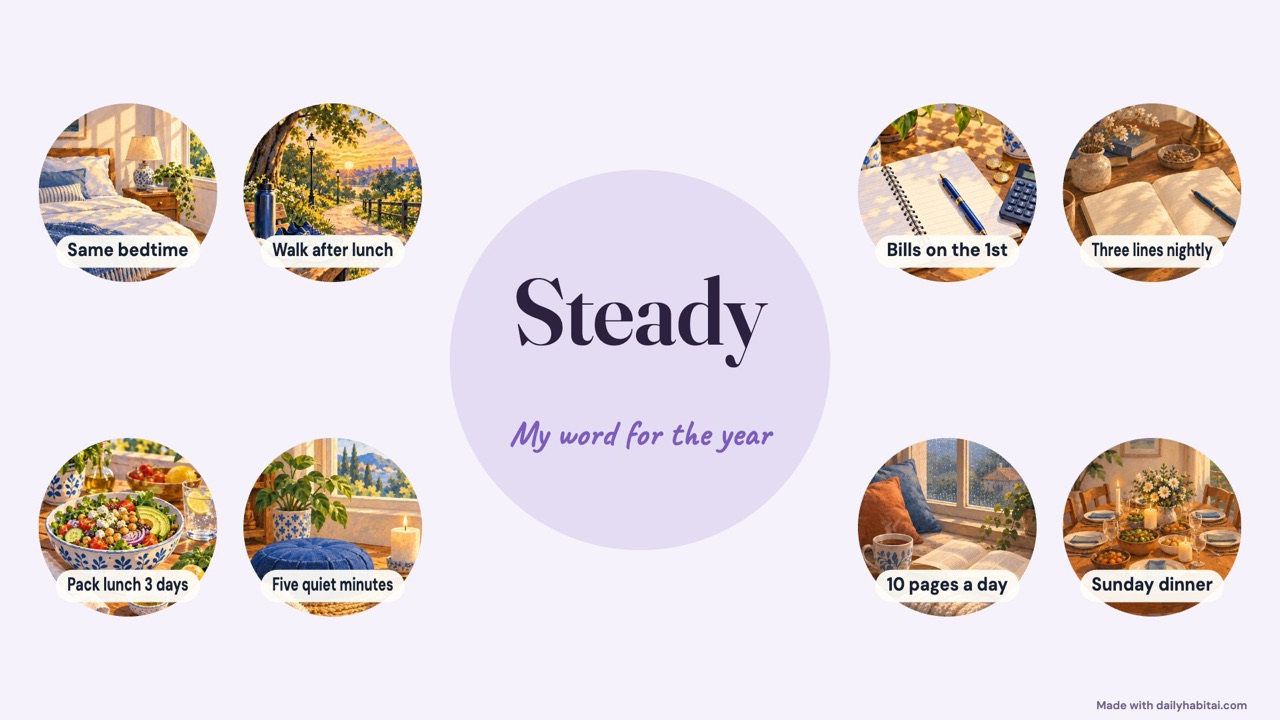
The weak spot of word-of-the-year boards is that a word can stay abstract. Steady means little until it becomes lights out at 11, a ten-minute walk after lunch or bills paid on the first. This page shows how to choose a word and turn it into eight pictures and a few daily habits.
Word of the year vision board ideas
Pictures to use
- A made bed for Rest or Steady
- A sunrise for Begin or New
- A still mountain lake for Calm
- A trail into the hills for Brave or Explore
- Garden beds for Grow or Tend
- A family table for Gather or Connect
- Running shoes for Strong or Move
- A journal for Reflect or Honest
- A coin jar for Enough or Simple
- A paint palette for Create or Play
- Books and glasses for Learn or Curious
- An open door for Open or Yes
- A candle for Peace
- A calendar with white space for Less
- Two mugs on a table for Love or Present
- A seedling for Patience
Words and phrases
- Steady
- Brave
- Rest
- Enough
- Grow
- Present
- Simplify
- Begin
- Trust
- Focus
- Gentle
- Bold
- Create
- Consistent
- Open
- Health
- Joy
- Finish
- Roots
- Balance
Print these and more with the vision board words sheet.
How to make a word of the year vision board
- Look back at the last year and write what you want more of and less of. Circle words that keep showing up.
- Test your top three words with one sentence: this year I want to be more ___ when ___. Keep the word that fits most days.
- Put the word in the center of the board in large letters.
- Around it, add six to eight pictures of what the word looks like on an ordinary day, not a perfect one.
- Write one small action under each picture, then choose one to practice daily for the next 30 days.
VISION BOARD + DAILYHABITAI APP
How to use your vision board with the DailyHabitAI app
Your board shows what you want. The free app handles the how: one picture becomes a 30-day plan with a small daily step and a reminder. No account, it stays on your phone.
From tile to daily habit
| Tile on your board | Daily habit in the app | Start |
|---|---|---|
| Same bedtime | Start my wind-down at 10:30, after the dinner dishes are done | Make it my plan |
| Walk after lunch | Walk for 10 minutes, after lunch | Make it my plan |
| Five quiet minutes | Sit and breathe for 5 minutes, after I get home | Make it my plan |
Five ways to use the board and the app together
- Board to plan in about two minutes. In the vision board maker, tap Make it a habit under any tile. The plan builder opens with your goal and your reason already filled in.
- Two nudges a day. Set the board as your lock screen and turn on the app's reminder at your cue time. You see the why on your wallpaper and get the small step from the app.
- Three goals at a time. The app keeps up to three active habits. Pick three tiles for this season, then archive one and bring in the next when it feels easy.
- Busy weeks do not break the board. Every day in the plan has a two-minute hard-day version, so a tile keeps moving even on a bad day.
- A monthly check-in. The app prompts short reviews on days 7, 14, 21 and 28. On the first of each month, look at the board and swap any picture that no longer fits.
Common mistakes to avoid
- Choosing a word that names an outcome, like thin or rich, instead of a way of acting.
- Picking a word that sounds impressive but does not fit the year you are actually facing.
- Leaving the word alone on the board with no pictures of what it means in practice.
- Changing the word every few weeks instead of giving it at least a season.
Frequently asked questions
How do I choose a word of the year?
Review last year, list what you want more and less of, and shortlist three words. Pick the one that describes how you want to act on an ordinary day, not a result. Good words are short and easy to apply in a moment of choice, like Steady, Brave, Rest or Focus.
What are good words of the year?
Popular choices include Steady, Brave, Rest, Enough, Grow, Present, Simplify, Begin, Trust and Focus. Choose a verb or a quality you can act on. If you are tired, a gentle word like Rest may fit better than a big one like Bold. The right word is the one you will use.
What goes on a word of the year vision board?
Your word goes in the center, large, with six to eight pictures of what it looks like in daily life. For Steady, that could be a regular bedtime, a daily walk, a packed lunch and bills paid on the first. Add one small action under each picture.
Can I have a word of the year and goals too?
Yes. The word guides how you act, and the goals say what you want to get done. Many people use the word as a filter for choosing goals. Research finds that turning goals into specific if-then plans helps, so give at least one goal a clear when and where.
Sources and evidence
- Gollwitzer & Sheeran (2006): Implementation intentions and goal achievement: A meta-analysis of effects and processes — Across 94 independent tests, if-then plans that say when, where and how you will act had a medium-to-large effect (d = .65) on reaching goals.
- Wang, Wang & Gai (2021): A meta-analysis of the effects of mental contrasting with implementation intentions on goal attainment — Across 21 studies (15,907 participants), pairing a wished-for future with its obstacles and an if-then plan had a small-to-medium effect on goal attainment (g = 0.336), with possible publication bias.
- Oettingen & Mayer (2002): The motivating function of thinking about the future: Expectations versus fantasies — Across four studies, positive fantasies about a desired future predicted lower effort and poorer results later, while positive expectations predicted higher effort and success. Picturing a goal is not enough on its own.