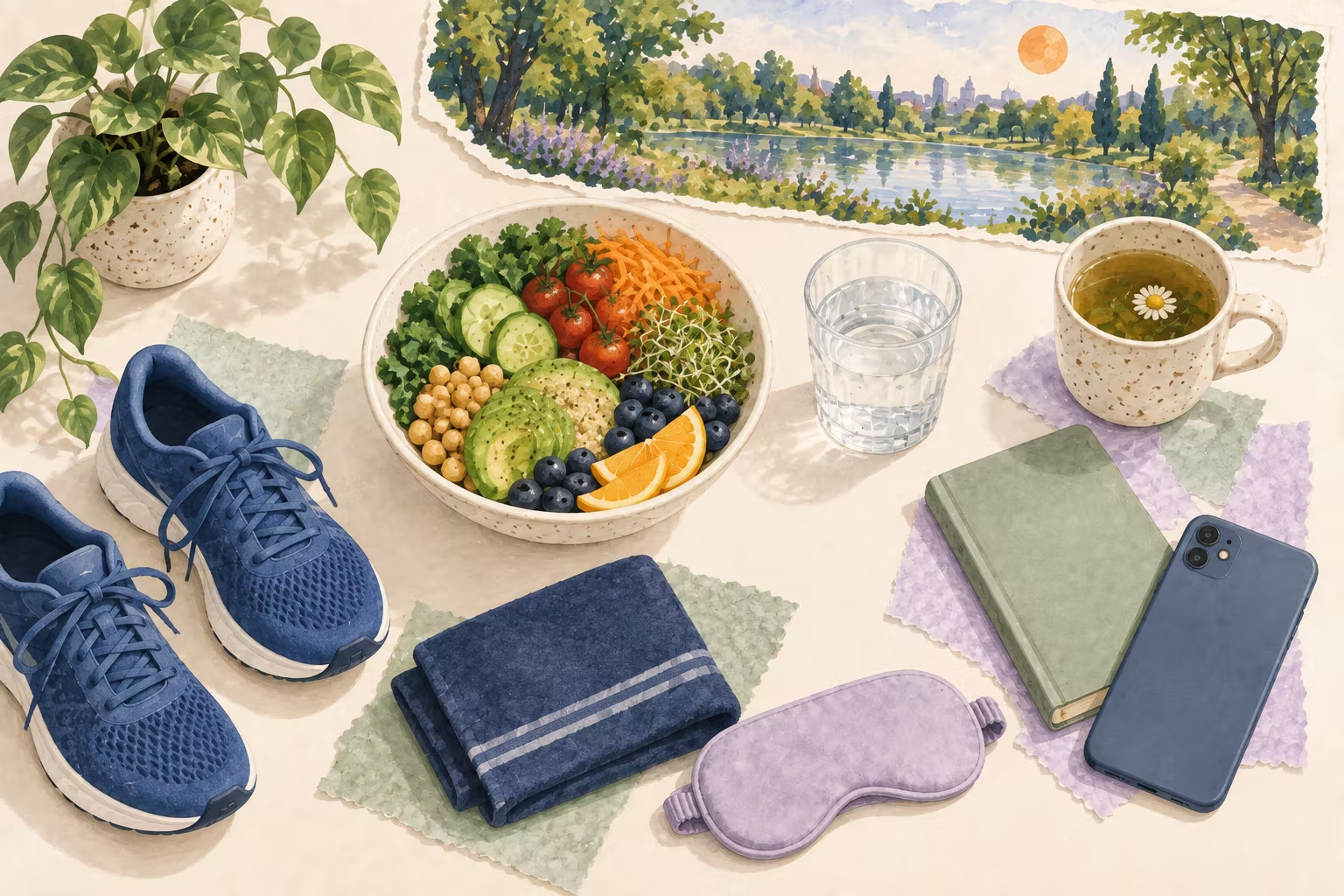
What are healthy lifestyle habits?
Healthy lifestyle habits are the everyday routines that public health guidelines agree on: enough sleep, regular movement, mostly whole foods, little or no alcohol, no tobacco, ways to handle stress, time with other people and some limits on sitting and screens. None of them needs to be perfect. Small, steady versions done most days count.
This guide gives the numbers from official sources for each of these seven areas, then one small starter habit and a free tool or 30-day plan to practice it. It is general information for healthy adults, not medical advice. If you have a health condition, are pregnant or take medication, ask your doctor what fits you.
Looking for a long list of habits to pick from instead? The good habits list has 50, each with a tiny first step. This page is the foundation underneath: the basics that most of those habits support.
The 7 healthy lifestyle basics at a glance
| Area |
What the guidelines say (adults) |
A small first habit |
Practice it with |
| Sleep |
7 or more hours a night (CDC, AASM) |
Same wake-up time every day |
Sleep calculator |
| Movement |
150 minutes of moderate activity a week plus 2 days of strength work (CDC, WHO) |
A 10-minute walk after lunch |
30-day walking plan |
| Food |
At least 400 g of fruit and vegetables a day; limit free sugars and salt (WHO) |
One extra vegetable at dinner |
Weekly meal planner |
| Alcohol and tobacco |
Drinking less is better than drinking more; no tobacco (CDC) |
Two alcohol-free weekdays |
Habit tracker |
| Stress |
Regular exercise, sleep, relaxation and connection (NIMH) |
Two minutes of slow breathing at your desk |
Meditation timer |
| Social connection |
Strong relationships linked to 50% higher odds of survival (meta-analysis) |
Message one person after dinner |
Habit stacking builder |
| Screens and sitting |
Limit sitting time and replace some of it with any movement (WHO) |
Phone charges outside the bedroom |
Screen time calculator |
How much sleep do adults need?
The CDC recommends 7 or more hours a night for adults aged 18 to 60, 7 to 9 hours at 61 to 64 and 7 to 8 hours from 65. The American Academy of Sleep Medicine and the Sleep Research Society reached the same 7-hour minimum in a joint consensus statement (Watson et al., 2015).
Regular timing matters as well as total hours. Our research summary on sleep regularity explains what studies show.
Starter habit: get up at the same time every day, weekends included, and set a "start winding down" alarm 45 minutes before your bedtime. The sleep calculator finds a bedtime for your wake-up time, and the 30-day evening routine plan builds the wind-down step by step.
How much exercise do adults need?
Adults should aim for at least 150 minutes of moderate activity a week, such as brisk walking, or 75 minutes of vigorous activity like running, plus muscle-strengthening activity on 2 or more days (CDC; WHO 2020 guidelines). That can be 30 minutes on 5 days, and shorter bouts count. According to the WHO, 31% of adults worldwide do not reach this level.
Starter habit: walk for 10 minutes right after lunch. Three of those a day on five days is already 150 minutes. Try the 30-day walking habit plan, and if you count steps, steps to miles turns them into distance and time. If you are starting from zero, read how to start exercising when out of shape.
What does a healthy diet look like?
The WHO advises adults to eat at least 400 grams of fruit and vegetables a day (about five portions), keep free sugars below 10% of daily energy and salt below 5 grams a day. The Dietary Guidelines for Americans, 2025–2030, say to build meals around whole, nutrient-dense foods, avoid highly processed salty or sweet foods and sugary drinks, and keep sodium under 2,300 mg a day from age 14.
Starter habit: add one vegetable to dinner, or swap one sugary drink a day for water. Plan three simple dinners a week with the weekly meal planner, or try the 30-day home cooking plan.
How much alcohol is OK, and what about tobacco?
The CDC's message on alcohol is simple: drinking less is better for your health than drinking more. If adults drink, the CDC describes moderate drinking as 2 drinks or fewer in a day for men and 1 or fewer for women, and people under 21 or who are pregnant should not drink at all. The 2025–2030 Dietary Guidelines also advise drinking less for better health.
For tobacco there is no safe level. The CDC lists how quickly quitting helps: within 1 to 2 years the risk of a heart attack drops sharply, and after 10 to 15 years the risk of lung cancer is about half that of someone who still smokes. Free help is available at 1-800-QUIT-NOW in the United States.
Starter habit: pick two weekdays with no alcohol and mark them on a habit tracker. If you smoke, the most useful first step is to call a quitline or talk to your doctor; this site does not replace that.
How can you manage stress day to day?
The National Institute of Mental Health suggests everyday self-care: regular exercise (even a 30-minute walk a day can lift mood), a steady sleep schedule, a relaxation practice such as breathing exercises or meditation, noticing things you are grateful for and staying in touch with people who support you. It also advises seeing a professional if problems like poor sleep or loss of interest last two weeks or more. In a crisis in the US, call or text 988.
Starter habit: after you sit down at your desk, take two minutes of slow breathing before you open email. The meditation timer has guided breathing, and the 30-day meditation plan starts at a few minutes a day. A 30-day gratitude challenge is another small daily option.
Why is social connection a health habit?
A meta-analysis of 148 studies with 308,849 people found that those with stronger social relationships had 50% higher odds of survival over the study periods than those with weaker ones (Holt-Lunstad, Smith and Layton, 2010). In 2023 the US Surgeon General's advisory on loneliness reported that about half of US adults had experienced loneliness and compared the health risk of social disconnection to smoking up to 15 cigarettes a day. These studies show strong associations; they cannot prove that loneliness alone causes illness.
Starter habit: after dinner, send one message to someone you have not talked to in a while. Link it to something you already do with the habit stacking builder.
How much screen time is healthy for adults?
There is no official daily screen-time limit for adults. The WHO's 2020 guidelines advise adults to limit the time spent sitting and replace some of it with physical activity of any intensity, and much of our sitting now happens in front of screens. Our guide on how much screen time is too much for adults looks at what studies do and do not show.
Starter habit: charge your phone outside the bedroom, and stand up or walk for a few minutes every hour you sit. The screen time calculator shows what your daily hours add up to over a year, and the 30-day screen time plan cuts back one scrolling moment at a time.
Which healthy habit should you start with?
Pick one. Starting all seven at once is the most common reason people drop all seven. Use this table to choose:
| If this sounds like you |
Start with |
Why |
| You wake up tired and rely on snooze |
Same wake-up time daily |
Sleep supports mood, energy and the other habits |
| You sit most of the day |
10-minute walk after lunch |
Short walks add up to the weekly target |
| You eat takeout most nights |
One home-cooked dinner a week |
Easier than a full diet change |
| Evenings end with a drink or two |
Two alcohol-free weekdays |
A clear rule you can track |
| You feel on edge by mid-afternoon |
Two minutes of breathing at your desk |
Fast, free and easy to repeat |
| You feel cut off from people |
One message after dinner |
A tiny daily step toward connection |
| Your phone is the last and first thing you see |
Phone charges outside the bedroom |
Changes the setting instead of relying on willpower |
Not sure which area of life needs attention most? Score them with the wheel of life and start with the lowest one you care about.
How do you make healthy habits stick?
- Make it small. A 10-minute walk you do beats an hour at the gym you skip.
- Tie it to something you already do. "After I finish lunch, I walk for 10 minutes." Plans that name when and where you will act are linked to better follow-through.
- Keep the same moment each day. In a real-world study, habits became automatic after anywhere from 18 to 254 days, and missing one day did not undo progress (Lally et al., 2010).
- Track it for a month. A tick on a habit tracker shows the pattern. After a missed day, simply start again at the next cue.
The plan builder turns any one of these into a 30-day plan with a small daily step, an easier version for hard days and reminders in the free app.
What does research say about combining healthy habits?
In two large US cohort studies following more than 120,000 adults for up to 34 years, people with all five low-risk factors (never smoking, a healthy body weight, at least 30 minutes a day of moderate to vigorous activity, moderate alcohol intake and a high-quality diet) had an estimated life expectancy at age 50 that was 14 years longer for women and 12.2 years longer for men than people with none of them (Li et al., 2018). The study was observational, so it shows an association, and most participants were health professionals. Still, it suggests the basics matter more together than any single one alone.