What is a good New Year's resolution for kids?
A good New Year's resolution for a child is one small thing the child will do, picked by the child, that they can repeat most weeks. "Feed the cat every morning" works. "Be good" and "get an A in math" do not, because a child cannot do either of them on a Tuesday.
This guide has 64 example resolutions in four age bands and eight areas, a 10-minute conversation to help a child choose, a 30-minute classroom lesson and the free one-page worksheet above. Children grow at different speeds, so read the bands on either side of your child's age too.
What makes a resolution work for a child?
The resolutions that last are small enough for a tired day, positive (something to start, not to stop), about a habit rather than an outcome, and chosen by the child. A child controls what they do, not the grade, the score or the team list. Your job is to help make the idea smaller.
| Instead of |
Try |
Why it works better |
| Get an A in math |
Practice math facts for 10 minutes after snack |
The child controls the 10 minutes |
| Stop fighting with my brother |
Say one kind thing to my brother at breakfast |
Something to do, not to avoid |
| Read more |
Read one book before lights-out |
A clear time and size |
| Be healthier |
Eat one piece of fruit at lunch |
One action instead of a wish |
| Make the team |
Practice kicking for 10 minutes on Saturdays |
Effort, not selection |
| Less tablet time |
Turn the tablet off when the timer rings |
One clear rule |
How do you help a child choose a resolution?
Have a short, relaxed talk in the last week of December or the first week of January. Sit side by side with crayons and the worksheet, and let your child do most of the talking.
- Minutes 1 to 2: look back. "What was the best part of this year? What are you proud of?"
- Minutes 3 to 4: the big wish. "If next year went really well, what would be different?" Accept a big answer, like "be a great artist." It goes at the top of the worksheet.
- Minutes 5 to 6: make it small. "What is one thing you could do each week that would help?" If they get stuck, offer two or three ideas from the lists below.
- Minute 7: when and where. "When would you do it? After snack? Before bath?" A step tied to something that already happens is easier to remember.
- Minute 8: who can help. "Who could help you? Who would you like to show?"
- Minutes 9 to 10: write and decorate. Your child writes or dictates the steps, draws the wish and picks where the sheet goes.
If your child does not want a resolution, that is fine. Share your own, or ask again on the first of a later month.
New Year's resolutions for kids ages 4 to 6
Preschoolers and kindergartners do best with one resolution in their own words, done with a grown-up.
- Kindness: Give a friend a high five at drop-off.
- Kindness: Say thank you to the bus driver or crossing guard.
- Health: Brush my teeth for a whole song, morning and night.
- Health: Try one bite of a new food on Sundays.
- School: Hang up my coat and bag when I get to class.
- School: Bring one drawing home in my folder each Friday.
- Home: Put my shoes on the mat when I come in.
- Home: Set the spoons and napkins on the table for dinner.
- Reading: Choose the bedtime book every night.
- Reading: Tell the story of a favorite book from the pictures.
- Screens: Turn off the show when the timer rings.
- Screens: Pick a toy, not a screen, for short car trips.
- Money: Put one coin in my piggy bank on Saturdays.
- Money: Count the coins in my jar with a grown-up each month.
- Nature: Water the plant on the windowsill on Mondays.
- Nature: Find three different leaves on a weekend walk.
New Year's resolutions for kids ages 7 to 9
Children in about first to fourth grade can pick a step, remember it with a chart and tell you how it went.
- Kindness: Ask someone new to play at recess once a week.
- Kindness: Make a card for someone in the family each month.
- Health: Fill my water bottle before school.
- Health: Play outside for 20 minutes after school.
- School: Pack my backpack the night before.
- School: Practice spelling words for 10 minutes after snack.
- Home: Make my bed before breakfast.
- Home: Feed the pet every morning.
- Reading: Read for 15 minutes before lights-out.
- Reading: Borrow one library book from a shelf I have never tried.
- Screens: Stop screens when the timer rings, without asking for more.
- Screens: Leave the tablet in the kitchen at night.
- Money: Save half of any money I get as a gift.
- Money: Keep a jar for one thing I am saving for.
- Nature: Put food scraps in the compost after dinner.
- Nature: Draw one bird or bug I see each weekend.
New Year's resolutions for kids ages 10 to 12
Preteens can plan their own steps and track them in a planner. Let them word the resolution themselves.
- Kindness: Call or text a grandparent once a week.
- Kindness: Help a younger sibling with one thing each day.
- Health: Lights out at the same time on school nights.
- Health: Try a new sport or active game once a month.
- School: Write homework in my planner before I leave class.
- School: Start homework before screens on school days.
- Home: Load the dishwasher after dinner on weeknights.
- Home: Make my own school lunch twice a week.
- Reading: Read for 20 minutes a day, any format.
- Reading: Finish one book a month and tell someone about it.
- Screens: Park my phone or tablet in the kitchen at bedtime.
- Screens: Spend one screen hour a week making something, like a comic or a song.
- Money: Write down my allowance and spending each Sunday.
- Money: Wait three days before buying anything over $10.
- Nature: Spend one weekend hour outside at a park or trail.
- Nature: Turn off the lights when I leave a room.
New Year's resolutions for teens
Teens should write their own; a resolution handed down by a parent rarely lasts. Offer this list as ideas and share your own.
- Kindness: Send one thank-you message a month.
- Kindness: Volunteer once a month, with a friend if possible.
- Health: Charge my phone outside my room at night.
- Health: Move for 30 minutes on three days a week, any way I like.
- School: Review the day's notes for 15 minutes after school.
- School: Plan the week's assignments every Sunday evening.
- Home: Cook one family dinner a week.
- Home: Do my own laundry on Saturdays.
- Reading: Read 20 pages before bed instead of scrolling.
- Reading: Read one book a month that I choose myself.
- Screens: Turn off notifications for my most distracting app.
- Screens: Keep one screen-free hour after dinner.
- Money: Save a set share of every paycheck or allowance.
- Money: Track every purchase for one month.
- Nature: Take a walk outside without headphones once a week.
- Nature: Carry a reusable water bottle and bag.
For a weekly study step like 54, the study schedule maker lays out the week in blocks.
How do you run a New Year's resolutions activity in class?
This 30-minute lesson works for about grades 1 to 6 in the first week back in January. You need one blank copy of the worksheet per student, crayons and a short read-aloud.
| Time |
Step |
What students do |
| Minutes 0 to 5 |
Read-aloud |
Listen to a short story about a fresh start, then say what the character changed |
| Minutes 5 to 10 |
Mini lesson |
Hear that a resolution is something you do, not something you get, with one "instead of, try" example on the board |
| Minutes 10 to 15 |
Pair share |
Ask a partner, "What is one thing you want to get better at?" and listen to the answer |
| Minutes 15 to 25 |
Worksheet |
Write or draw the wish, three small steps, who can help and how they will remember |
| Minutes 25 to 30 |
Share and display |
Volunteers read one step aloud; sheets go in folders or on a board with first names only |
For the read-aloud, Squirrel's New Year's Resolution by Pat Miller (2010) is a picture book about working out what a resolution is, with a helping-others theme. Older grades can hear a few pages of Amelia's Must-Keep Resolutions for the Best Year Ever by Marissa Moss (2006), written as a girl's notebook. Any short story about trying something new works too.
A few classroom tips:
- Keep it about effort. Steer away from grades, weight or things to buy, so no child feels behind a classmate.
- Make sharing optional. A child who wants the wish private can fold the top of the sheet over.
- Scribe for young writers. In kindergarten and first grade, students draw and an adult writes their words.
- Plan the check-in now. Put the first school day of each month in your calendar for a five-minute star check.
How do you use the printable worksheet?
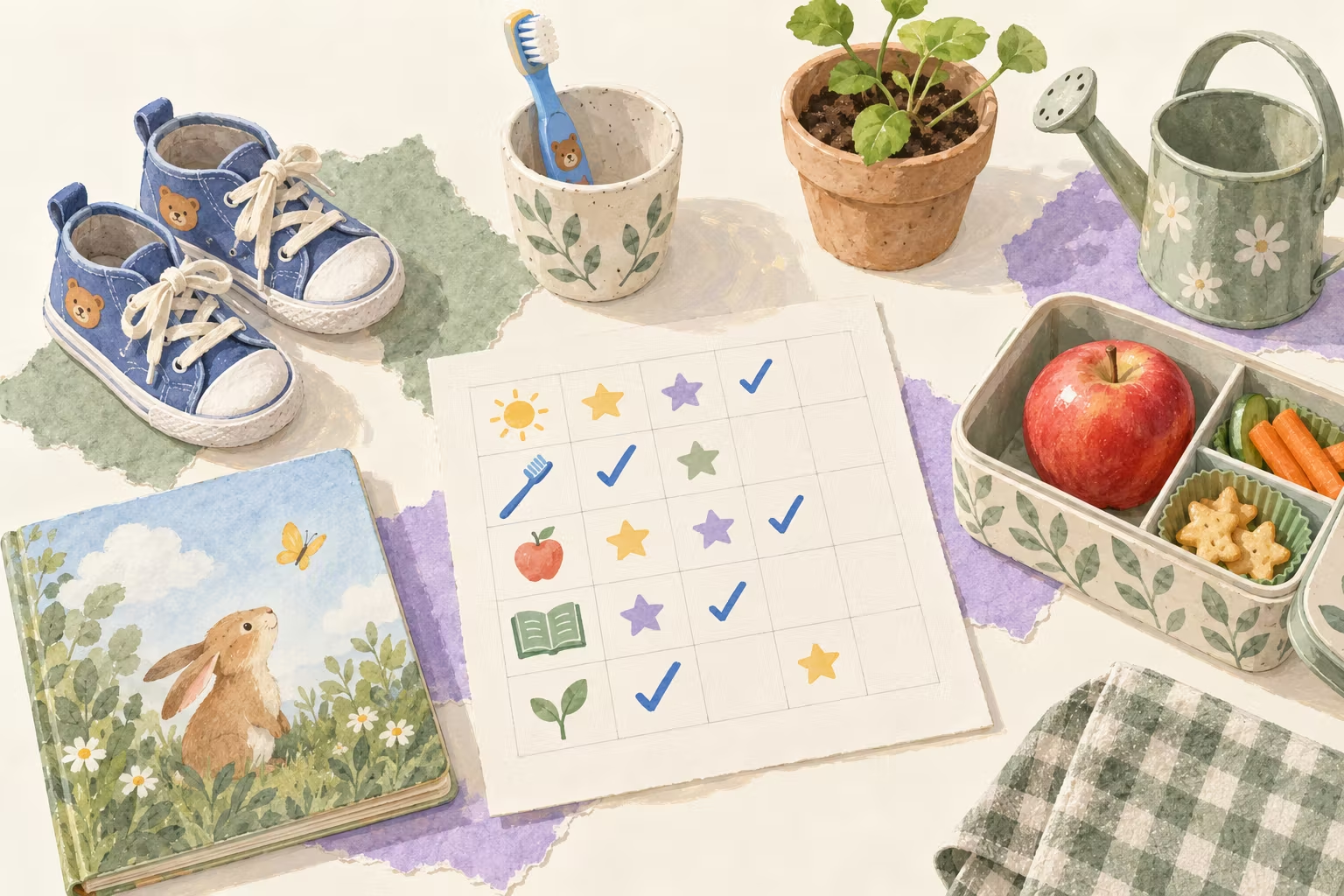
The worksheet at the top of this page prints on one Letter or A4 page, filled in or blank. Write the wish in the child's words, give each small step a day or a time, and keep the 12 stars for the monthly check-ins. Put my steps on a star chart opens the free habit tracker template on its kids star chart design with the three steps filled in, for a week-by-week chart.
How do you keep a kid's resolution going after January?
Most resolutions fade in February because nobody looks at them again. A short monthly check-in fixes much of that.
- Put the sheet where the habit happens. On the fridge, by the bed or in the homework folder.
- Check in once a month. On the first weekend of each month, ask: What did you do? What was hard? Keep it, change it or make it smaller?
- Color a star. If your child kept going most weeks, they color that month's star. If not, leave it empty without comment.
- Add a weekly chart for hard months. A reward chart holds one step with stickers toward a small reward your child helped choose. The kids star chart on the habit tracker template holds up to six daily habits. For behaviors such as kind words, a behavior chart fits better.
- Restart on any first. A missed month is not a failed year. The next first of the month, a birthday or a new term all work.
- Grow it slowly. After three steady months, add a new step or make the first one a little bigger.
Praise the effort you saw in specific words: "You fed the cat every morning this week without a reminder."
If a picture keeps the wish in sight, the guide to a vision board for kids shows how to make one by age, and the vision board maker builds one on screen.
What does a worked example look like for an 8-year-old?
Maya is 8 and in third grade. On December 30, she and her dad have the 10-minute talk.
- Look back: Her proudest moment was a fox drawing her teacher hung on the wall.
- Big wish: "I want to draw animals that look real."
- Three small steps: "Draw an animal after snack, Mon and Wed," "Borrow one animal book at the library" and "Show Grandma one drawing every Sunday."
- Who can help: Grandma, who video-calls on Sundays, and the school librarian.
- How I will remember: Her sketchbook lives next to her snack plate, and the worksheet is on the fridge.
On the first Sunday in February, Maya has drawn on most Mondays and Wednesdays, and she colors the January star. In February a cold keeps her in bed for a week and she misses most of her sessions. Her dad does not comment. The February star stays empty, and she colors March.
In April she adds a step: drawing a real animal at the park on Saturdays. Her dad puts the steps on a reward chart for the spring, with a new sketchbook as the reward she picked. None of her steps says "win the art contest." Each is something she can do this week.
What are common mistakes with kids' resolutions?
- Too many. Five resolutions often turn into none. Start with one wish and three small steps.
- Adult-chosen. "Your resolution is to keep your room clean" is a chore with a new name. Offer ideas and let the child pick.
- Outcome goals. "Get an A," "make the team" and "win the spelling bee" depend on things a child cannot control. Turn each one into the practice behind it.
- About weight or looks. Keep health resolutions about actions, like playing outside, drinking water or trying a new food, never about body size.
- Big prizes. A large prize can make the resolution about the prize. Keep rewards small and lean on praise and the star tracker.
- Taking stars away. Once a star is colored, it stays. Deal with misbehavior separately.
What does research say about helping kids keep resolutions?
There is little research on children's New Year's resolutions as such. Most studies below are from adults, so treat them as support for the method, not as a promise.
- Tracking helps. Across 138 randomized studies with 19,951 participants, mostly adults, monitoring progress improved goal attainment, more so when progress was physically recorded or reported to others (Harkin et al., 2016). A star tracker on the fridge does both.
- Planning when and where helps. Across 94 tests, if-then plans such as "after snack, I draw" had a medium-to-large effect on reaching goals, though few studies involved young children (Gollwitzer & Sheeran, 2006).
- Big expected rewards can backfire. Across 128 experiments, expected tangible rewards lowered later free-choice interest in an activity, more so for children than college students, while positive feedback raised it (Deci, Koestner & Ryan, 1999).
- Fresh starts pull. Searches for "diet," gym visits and goal commitments by adults rose after a new week, month or year, or a birthday (Dai, Milkman & Riis, 2014). That supports the first of each month as a restart day.
- Praise and small rewards. The CDC advises picking a couple of specific behaviors and never taking away a reward a child has earned (CDC). The American Academy of Pediatrics notes that stars suit early school-age children and that children should help choose rewards (AAP, HealthyChildren.org).
When should you talk to a teacher or pediatrician?
Most resolutions need nothing more than a grown-up who checks in. Talk to your child's teacher if a school resolution keeps slipping because the work itself seems much harder for them than for classmates.
Talk to the pediatrician if your child wants a resolution about weight or food, seems very worried about getting things wrong, or if sleep, eating or mood changes for more than a couple of weeks.
Where should you go from here?
Have the 10-minute talk this week, fill in the worksheet together and put it on the fridge. For daily habits beyond resolutions, the list of good habits for kids has 50 ideas by age with a printable star chart. If your child's wish is about books, the reading challenge for kids turns it into 24 printable prompts.
Making a resolution of your own alongside your child? The New Year's resolution ideas list has 65 for adults, each as a small habit, and the guide to goals for the year ahead covers bigger goals. For a family habit, the 30-day habit building plan walks through the first month day by day, or you can build your own 30-day habit plan. More ideas are in the habit-building topic hub.