
FREE PRINTABLE · AGES 3 TO 13
Printable morning routine chart for kids
Make a printable morning routine chart for kids: pick or add picture steps, add a name and print a checklist, a weekly chart or cut-apart picture cards.
My morning routine
Steps
Rename, reorder or remove any step. Tap a picture to change it.
More step ideas for this age
Your chart is saved on this device only.
The short answer
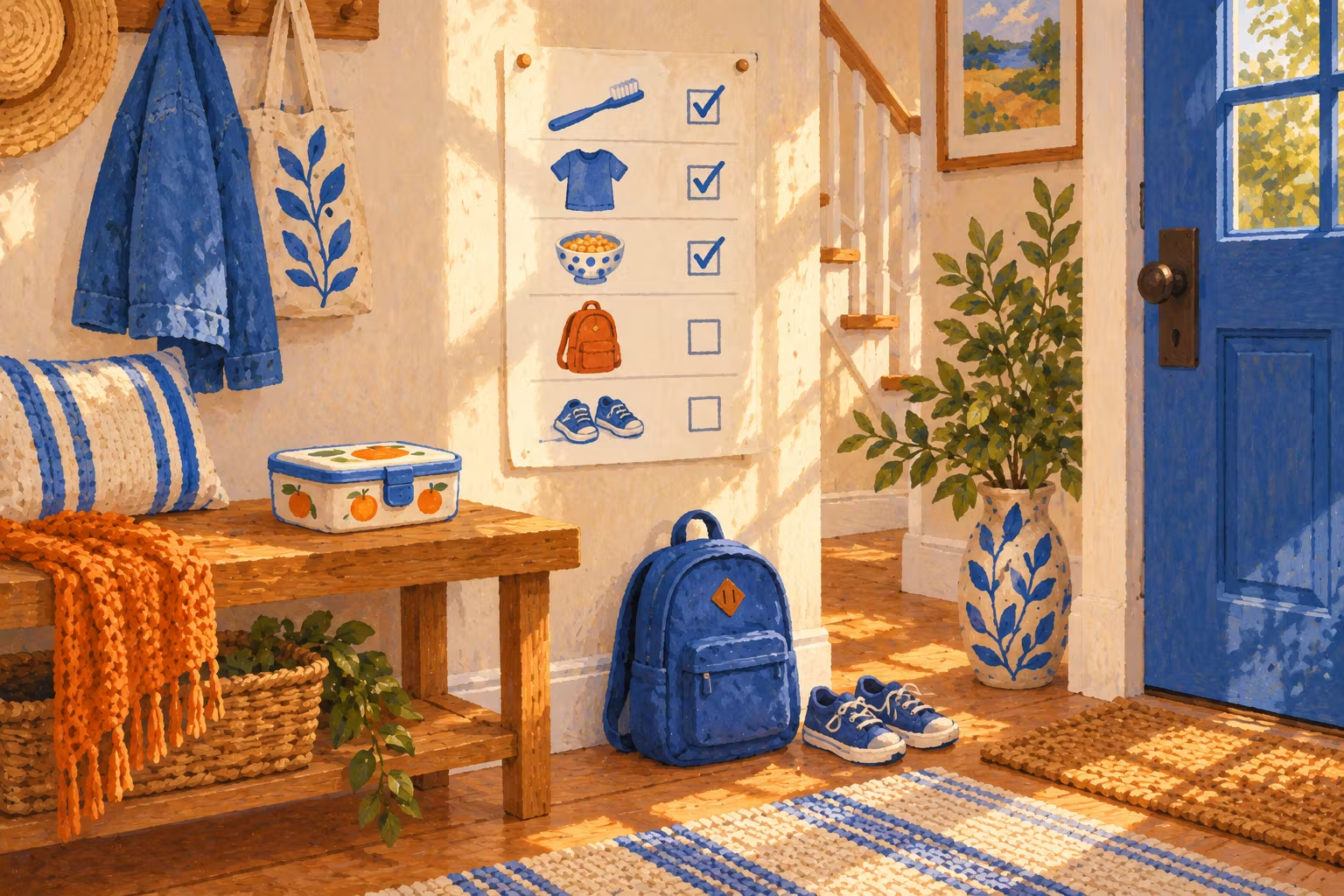
A good kids morning routine chart has 5 to 8 steps in the same order every school day, one picture per step and a box to tick. Younger children do best with fewer steps and pictures; older kids can add times. Prepare clothes and bags the night before, and let your child tick each step themselves.
Sample morning routines for kids by age
| Age | Morning routine | Tip |
|---|---|---|
| Ages 3 to 5 | Wake up and get out of bed → Use the toilet → Get dressed → Eat breakfast → Brush teeth → Shoes and coat on | 4 to 6 picture steps, no times. |
| Ages 6 to 9 | Wake up and get out of bed → Get dressed → Make the bed → Eat breakfast → Brush teeth → Brush hair → Shoes and coat on → Pack the backpack | 6 to 8 steps, pictures and words. |
| Ages 10 to 13 | Wake up and get out of bed → Wash face and hands → Get dressed → Make the bed → Eat breakfast → Brush teeth → Pack lunch and water bottle → Pack the backpack → Check: homework, planner, keys | 7 to 9 steps, with a final check. |
How to make a morning routine chart work
- Make it together. Let your child choose the order where it does not matter, and help decorate the printout.
- Hang it where the routine happens. At eye level, near the bedroom door or the breakfast table.
- Keep the same order every school day. The same sequence is what lets the chart fade into habit.
- Let them tick the boxes. A pen on a string or a dry-erase sleeve makes it reusable.
- Prepare the night before. Clothes laid out and a packed bag by the door remove most morning battles.
How much sleep do kids need before a school morning?
Sleep experts recommend 10 to 13 hours in 24 hours for ages 3 to 5 (naps included), 9 to 12 hours for ages 6 to 12 and 8 to 10 hours for teens. Count back from wake-up time to set bedtime, then use the evening chart to make the last hour predictable. For adult bedtimes, try the sleep calculator.
More printable charts for kids
Plan the hours after school with the after school routine chart (snack, play, homework and screens, with times), make the evening just as easy with the bedtime routine chart, and share out household jobs with the chore chart maker.
Routines for the grown-ups too
Children copy the rhythm around them. Build your own with the morning routine generator, read how to build a morning routine or start the 30-day morning routine plan.
Frequently asked questions
How many steps should a kids morning routine have?
About 4 to 5 for preschoolers and 6 to 8 for school-age kids. Fewer, clear steps are easier to follow than a long list.
Should I use a checklist, a weekly chart or picture cards?
A checklist is simplest for most children. A weekly chart with Monday to Friday columns lets older kids see their week. Picture cards print six to a page to cut out for a velcro strip or a flip chart, which suits children who cannot read yet.
Can I add my own steps?
Yes. Add any step with your own words and a picture, rename or remove the suggested ones, and use the arrows to put them in the order your mornings actually go. The chart is saved in your browser on this device.
How do I print the chart from my phone?
Use Save as image to get a letter-size picture of the chart, then print it from your photos or send it to a printer later. Black and white mode saves colored ink.
What time should kids wake up for school?
Count back from when you need to leave, allowing 30 to 60 minutes for the routine. Then set bedtime so your child gets enough sleep: 9 to 12 hours for ages 6 to 12, according to sleep experts.
How do I get my child to follow the chart?
Make it together, keep it at their eye level, do the same order every day and let them tick the boxes. Praise the steps they do rather than pointing out the ones they miss.
Sources and evidence
- Paruthi et al. (2016): Recommended amount of sleep for pediatric populations (AASM consensus) — Children 3 to 5 should sleep 10 to 13 hours per 24 hours, 6 to 12 year olds 9 to 12 hours and teens 13 to 18 8 to 10 hours.
- Gollwitzer and Sheeran (2006): Implementation intentions and goal achievement — Tying an action to a specific moment linked to better follow-through across many studies.