2027 Reading Bingo
Read a book that fits a square, then tap it.
dailyhabitai.com/tools/reading-bingo/
 DailyHabitAI
BOOK BINGO 2027 · PRINTABLE
Free reading bingo card maker: 3x3, 4x4 or 5x5 book bingo for adults, kids, teens and book clubs. Tick books, print 1, 2 or 4 per page.
0 of 24 read · tap a square when you finish a book
Read a book that fits a square, then tap it.
dailyhabitai.com/tools/reading-bingo/
On 3x3 and 5x5 cards. The free square counts as read.
A 5x5 card needs 24 squares, a 4x4 card 16 and a 3x3 card 8. Empty squares stay blank to write in. Up to 40 characters each.
The same number, set and size always give the same card, so a group can share one.
Your card, ticks and titles are saved in this browser only. Nothing is sent to our server.
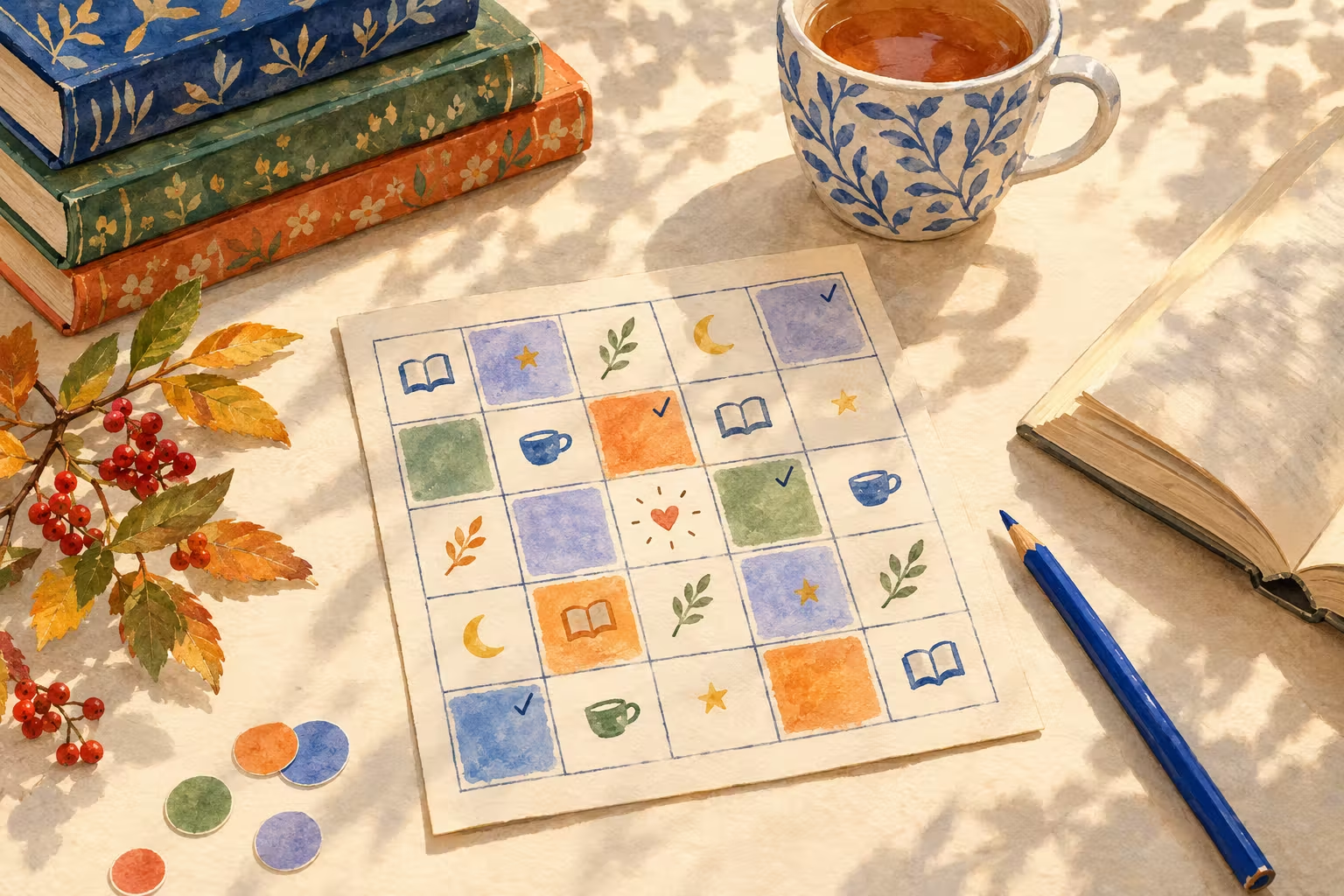
Reading bingo is a reading challenge on a bingo card. Each square holds a book prompt, such as a book under 200 pages or a book from the library. Read a book that fits a square, write its title there and mark it. Five squares in a row, column or diagonal make a bingo; every square is a blackout.
Book bingo and reading bingo are the same game. This card maker has 7 square sets with 42 to 46 prompts each, three card sizes and a free center, and it prints one card or a page of 2 or 4 different cards. For a full year of prompts as a list instead of a card, use the 2027 reading challenge; both live on the reading hub.
Choose one rule before you start. Groups often play for a first line, then keep going for a blackout.
| Rule | What you need | Books on a 5x5 card | Good for |
|---|---|---|---|
| Bingo | One full row, column or diagonal | 4 through the center, 5 elsewhere | A first goal, kids, a month |
| Two or three bingos | Two or three full lines | 8 to 15 | A season or a school term |
| Four corners | The four corner squares | 4 | A quick classroom week |
| X | Both diagonals | 8 | A book club over a few months |
| Blackout | Every square | 24 (25 without the free center) | A year-long reading challenge |
The card counts rows, columns and diagonals for you and shows how many squares are left for the next line. Four corners and X are easy to check by eye.
The Adults 2027 set mixes genre, format, length, author and setting, so a line pulls you a little outside your usual shelf without turning reading into homework. A few squares that are not on the first card:
Put at least one short book in every row, such as a book under 200 pages or a book you finish in a day, so each line has a quick win. The 52 reading challenge prompts for 2027 have more ideas tied to real dates, and how to read more has ways to fit the books into a normal week.
The Kids set is written for picture books and early readers, with squares children can do on their own or with a grown-up. The free center is read with a grown-up.
Use a 3x3 card for preschool and kindergarten and a 4x4 card for early grades, so a line comes within a week or two. Read-alouds count. Let the child color the square or put a sticker on it, and keep the card on the fridge. For a record of minutes, the reading log has a kids layout with a parent signature and weekly totals.
The Teens set leans on what teens choose for fun: manga and graphic novels, series, romance, fantasy with a map and books that became a show. Squares such as a graphic novel or manga or a book that became a show give a reluctant reader an easy way in.
The Book club set has prompts a group can share: a book picked by the newest member, a book you will argue about, a book with a film to watch after. Print 4 per page so every member gets a different card, and let the club's pick count as a free square for everyone. At each meeting, go round and say which square your last book filled.
For a seasonal game, the Winter and cozy set works as a winter reading challenge from December to February, and the Classics and Nonfiction sets suit readers who want a theme for the whole year.
Keep prizes small and praise specific. In a review of 128 experiments, expected tangible rewards for doing an interesting activity lowered people's later interest in it, while positive feedback raised it (Deci, Koestner and Ryan, 1999). Most studies in that review were with children and college students on short tasks, not reading programs, so treat it as a guide, not a rule.
Reading for fun is worth the nudge. Across 99 studies with 7,669 people from preschool to university, those who read more in their free time had better reading comprehension and spelling (Mol and Bus, 2011). Those studies show a link, not that a bingo card itself makes anyone a better reader.
| Tool | How it works | Best for |
|---|---|---|
| Reading bingo | 9 to 25 prompts on a card; lines and blackout | Variety, kids, classrooms, book clubs |
| Reading challenge | 52 prompts, one a week, as a checklist | A full year of books with a list |
| Book tracker | A bookshelf you color one spine at a time | A number goal, like 24 books a year |
| Reading log | Days, minutes and pages | A daily habit or a school log |
To make the reading itself a habit, follow the 30-day reading habit plan or build a reading plan around your day. Want a bingo card for other small goals? Try self-care bingo.
A full straight line of read squares: a row, a column or one of the two diagonals. On a 5x5 card the free center counts for everyone, so a line through the middle needs only four books. A bingo is four in a line on a 4x4 card and three on a 3x3 card.
That is the organiser's rule. Most games say one book per square, so a 5x5 card means 24 different books. A common middle ground: a book may fit two prompts, but you choose one square for it. On your own card, decide before you start and keep the rule all year.
In most reading challenges, yes: listening to a whole book counts, and the adult set has its own audiobook square. A classroom may ask young readers to read print books for most squares, so check the organiser's rules. Graphic novels and e-books count too.
24 books with the free center, 25 without it. A first bingo can take as few as four books, through the center. At one book a week a blackout takes about six months; at two books a month, about a year. A 4x4 card is 16 books and a 3x3 card 8 or 9.
Pick a size and a square set, then press Shuffle until you like the card. Tap any square to change its text. To write every prompt yourself, open Customize and type one per line, or choose Blank card and write on paper. Then print one card, or 2 or 4 different cards on a page.
Yes. Press Print and choose Save as PDF in the print dialog for a one-page PDF on Letter or A4. For a class or book club, print 2 or 4 cards per page: each has its own shuffle and card number, so you can print the same card again later.
Squares children can do on their own: a book with an animal hero, read to a pet or a toy, a book from the library, read in a blanket fort. Use a 3x3 or 4x4 card for younger readers so a line comes quickly, and let them color in the square themselves.
Yes, in this browser on this device: your ticks, book titles and edited squares. Nothing is sent to our server and there is no sign-up. Print the card or save it as an image to keep a copy somewhere else.
New plans, guides and app features, a few times a month at most.